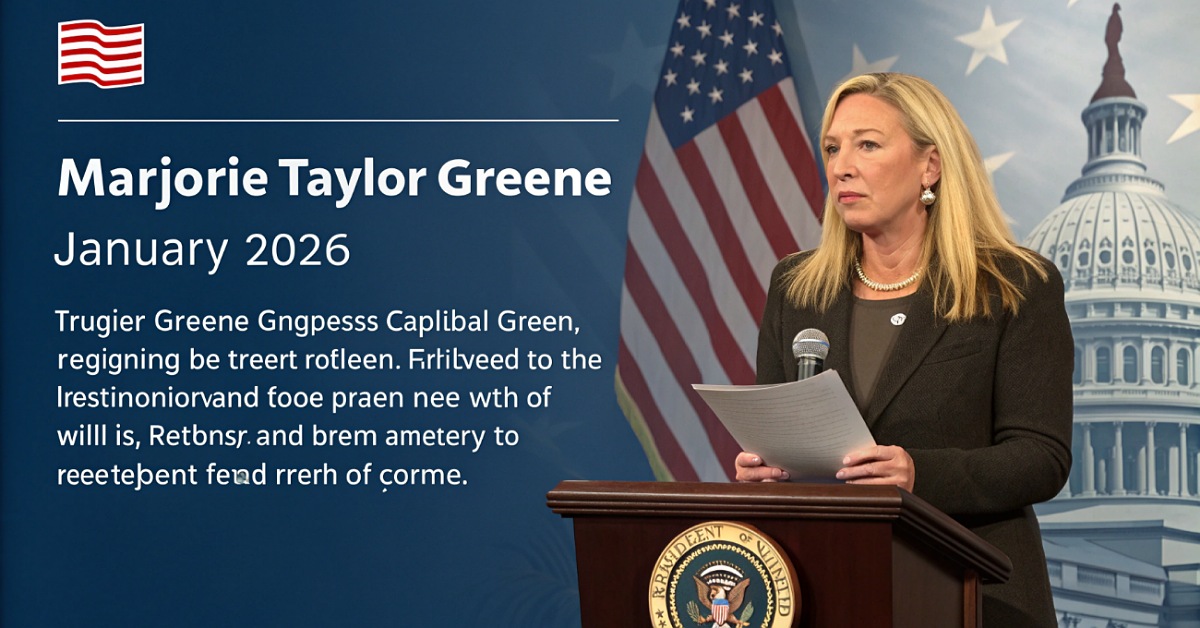
Marjorie Taylor Greene announces her resignation from Congress effective January 5, 2026, following a dramatic split with President Trump over the Epstein files vote. Here’s what happened and why.
The Big News: MTG Is Resigning From Congress
Marjorie Taylor Greene, the controversial Republican representative from Georgia’s 14th congressional district, announced on Friday evening that she will be resigning from Congress effective January 5, 2026. The announcement came through a 10-minute video and a detailed written statement shared on social media, marking a stunning end to her tenure in Washington after serving since 2021.
The resignation announcement sent shockwaves through Capitol Hill and the political landscape, especially given the timing and circumstances surrounding her departure. Greene, who was once considered one of President Trump’s most loyal allies in Congress, will now be leaving office following a highly publicized and bitter dispute with the former president.
The Trump-Greene Feud: How It All Started
To understand why Marjorie Taylor Greene is resigning from Congress, you need to understand the dramatic falling out between her and President Trump. The conflict centered on a single issue that became deeply personal for both: the release of Jeffrey Epstein files.
Greene emerged as a vocal advocate for transparency regarding documents connected to the late convicted sex offender Jeffrey Epstein. She joined other Republican representatives in signing a bipartisan discharge petition known as the Epstein Files Transparency Act, which would compel the Department of Justice to release all documents related to Epstein, including flight logs, travel records, and names of individuals connected to the investigation.
This support for transparency put her directly at odds with President Trump, who has consistently resisted the release of these documents. Trump apparently took the matter very personally, viewing Greene’s position as a betrayal.
Trump Withdraws His Endorsement: “Ranting Lunatic” Comment
The situation escalated dramatically on November 14 when President Trump announced he was officially withdrawing his endorsement of Marjorie Taylor Greene. In his statement on Truth Social, Trump used harsh language, calling her a “ranting lunatic” and accusing her of going “far left.”
Trump claimed he couldn’t respond to her phone calls because he was busy managing the country, with 219 Congress members, 53 Cabinet members, and countries to deal with. He also suggested that he would support a GOP challenger against Greene in the next primary election, essentially declaring war on someone who had been among his most vocal supporters.
But Greene fought back, sharing text messages she had sent to Trump on social media. She argued that Trump was targeting her to intimidate other Republicans ahead of the vote to release the Epstein files. In her response, she suggested that Trump’s reluctance to release the documents was actually a “huge miscalculation” and defended her position, saying she didn’t believe Trump had “anything to conceal.”
Why Is Marjorie Taylor Greene Resigning? Her Reasons Explained
In her resignation announcement, Greene provided several reasons for her decision to step down. First and foremost, she wanted to avoid a painful primary battle with Republicans. She expressed concern that fighting off a Trump-backed challenger would be distracting during a time when Republicans would likely lose House control in the midterms.
“I have far too much self respect, I love my family immensely, and do not wish for my beloved district to endure a painful and hostile primary instigated by the President,” Greene stated in her explanation of why she decided to resign from Congress.
Beyond the immediate Trump feud, Greene’s resignation letter also highlighted her frustration with Capitol Hill dysfunction. She criticized the longest government shutdown in American history, which she said resulted in the House not working for eight weeks. She expressed disappointment that the Republican-controlled legislature had been “mostly sidelined” despite having an almost one-year majority.
Greene also detailed her legislative work and accomplishments, including efforts to impeach the Secretary of Homeland Security, defunding NPR and PBS, fighting against foreign wars, and demanding the release of Epstein files. However, she concluded that loyalty should be reciprocal and that she should be able to vote her conscience and represent her district’s interests without facing retaliation.
The Epstein Files: The Real Issue Behind the Resignation
While Greene’s resignation statement mentions multiple frustrations with Congress and Republican leadership, the elephant in the room is clearly the Epstein files issue and her conflict with Trump. The Epstein matter has been intensely controversial, with Trump facing increased scrutiny regarding his alleged connections to the convicted sex offender.
Democrats on the House Oversight Committee have been investigating potential links between Trump and Epstein. However, Trump has persistently urged his supporters to dismiss these claims as a “hoax.” Greene, meanwhile, has taken a different approach by calling for complete transparency on the documents—a position that directly contradicts Trump’s apparent wishes.
The irony is that Trump actually signed a transparency measure related to Epstein into law earlier this week, apparently reversing course on the issue. However, by then, the damage to his relationship with Marjorie Taylor Greene had already been done.
Death Threats and Personal Safety Concerns
Another factor that may have influenced Greene’s decision to resign relates to personal safety. Following Trump’s harsh criticism calling her a “traitor” and labeling her a “ranting lunatic,” Greene reported receiving death threats.
In interviews after the Trump fallout, Greene expressed that she had been mulling over her resignation for more than a week as the threats against her intensified. While she didn’t explicitly state that death threats were the primary reason for her resignation, she did acknowledge receiving threats in the context of the political turmoil surrounding the Epstein files vote.
Who Is Marjorie Taylor Greene? Her Congressional Record
To understand the significance of her resignation, it’s important to understand who Marjorie Taylor Greene is and what her role has been in Congress. Greene was first elected in 2020 to represent Georgia’s 14th congressional district. She quickly gained attention for promoting conspiracy theories and using provocative language, which led to controversy early in her career.
During her first year in Congress, the Democratic-led House under Speaker Nancy Pelosi took the unprecedented step of removing Greene from committee assignments due to her past endorsements of violence and controversial statements about school shootings. Despite this setback, Greene became known as a fiercely loyal Trump supporter—even wearing a “Make America Great Again” hat during Joe Biden’s 2021 State of the Union address.
Over her four-year tenure, Greene carved out a reputation as one of the most vocal and controversial members of Congress. She wasn’t afraid to criticize Republican leadership, including Speaker Mike Johnson, especially during recent disputes over government spending and healthcare policy.
The Government Shutdown Criticism
Tensions between Greene and Republican leadership had been building for weeks before the Trump Epstein files dispute. During the federal government shutdown—the longest in American history—Greene openly criticized House Speaker Mike Johnson and called out the Republican Party’s handling of the situation.
She also took stands that sometimes defied her own party, particularly on issues like healthcare. Greene expressed frustration that enhanced subsidies under the Affordable Care Act were set to expire, calling herself “absolutely disgusted” at the prospect of insurance premiums potentially doubling. She was even open to working with Democrats on healthcare deals, showing a willingness to break ranks with Republican orthodoxy when she felt constituents’ interests were at stake.
What Comes Next? The Impact on Congress
Marjorie Taylor Greene’s resignation will have immediate repercussions for House Speaker Mike Johnson, who already faces a precarious majority. With Republicans holding a narrow margin in the House, losing any representative makes the majority even thinner and more vulnerable.
Greene’s departure during an election cycle also means that Georgia voters will need to select a new representative for the 14th district. Speaker Johnson will have to work to unite his already divided conference to advance legislation and support the president’s agenda in 2026.
Some Republicans expressed sadness at Greene’s departure. Rep. Thomas Massie wrote on X: “I’m very saddened for our country but incredibly happy for my friend Marjorie. I will miss her greatly. She exemplifies what a true Representative should be.”
Has Marjorie Taylor Greene Changed? Her Own Reflection
In her resignation statement and subsequent interviews, Greene showed signs of personal reflection. She acknowledged that her years of “toxic” rhetoric may have contributed to a climate of escalating political violence in America.
This represents something of a departure from the aggressive, confrontational posture she took during her earlier years in Congress. While Greene still defended many of her legislative positions, she appeared to recognize the human cost of extreme political polarization.
Will MTG Run for Office Again?
Currently, according to sources close to Greene, the congresswoman has no intentions of pursuing any other political office in the near future. This marks a significant departure from earlier speculation that she might run for Georgia’s competitive Senate seat.
Her resignation appears to signal a complete step back from electoral politics, at least for now. Whether this is permanent or temporary remains to be seen, but Greene’s immediate political future appears to be outside of Congress.
The Bigger Picture: Trump’s Political Influence
Marjorie Taylor Greene’s resignation also reflects the broader power dynamics within the Republican Party and Trump’s significant influence over GOP members. Despite decades of service in politics, Trump was able to push out one of his most loyal supporters through public attacks and the threat of backing a primary challenger.
This demonstrates both Trump’s continued power within Republican circles and the vulnerability of even high-profile GOP members to his attacks. Few Republicans have publicly stood up to Trump in the way Greene did regarding the Epstein files, and her experience suggests there could be a steep political price for doing so.
Why This Matters to Americans
Marjorie Taylor Greene’s resignation matters beyond just Washington political drama. Her departure affects how the House operates, the balance of power in Congress, and what legislation can actually get passed in the coming months. With an even thinner Republican majority, the dynamics of legislative power shift significantly.
Additionally, the circumstances surrounding her resignation raise questions about political loyalty, free speech within political parties, and whether elected representatives should be allowed to vote their conscience on important issues without facing retaliation from party leadership or a former president.
Conclusion
Marjorie Taylor Greene’s announcement that she is resigning from Congress effective January 5, 2026, marks the end of a tumultuous four-year chapter in American politics. The Georgia Republican’s decision follows a dramatic split with President Trump over the Epstein files, government shutdown frustrations, and concerns about a contentious primary battle backed by Trump’s political machine.
What started as a principled stand on transparency regarding Jeffrey Epstein documents evolved into a full-scale political battle that ultimately cost Greene her seat in Congress. Whether you view her as a principled representative standing up for transparency or as someone facing deserved consequences for challenging Trump, there’s no denying that her resignation represents a significant moment in contemporary American politics.
The immediate impact will be felt in Congress, where Speaker Johnson already faces a narrow majority. The longer-term implications for political loyalty, party discipline, and the boundaries of Trump’s influence within the Republican Party remain to be seen.