Read the complete 2025 Toyota Tacoma i-FORCE MAX review — explore its hybrid powertrain, performance, design, features, and real user experience. Find out if it’s the right midsize truck for you.
Introduction
The 2025 Toyota Tacoma i-FORCE MAX isn’t just another midsize pickup truck—it’s a game-changer in the automotive world. Toyota’s first-ever hybrid truck engine brings a refreshing blend of raw power and fuel efficiency to a segment that hasn’t seen significant innovation in years. After nearly a decade without a complete redesign, the fourth-generation Tacoma emerges not just modernized, but revolutionized.
The 2025 Tacoma i-FORCE MAX combines a 2.4-liter turbocharged engine with an electric motor to deliver 326 horsepower and an impressive 465 lb-ft of torque. This hybrid powertrain translates to better towing capacity, enhanced off-road performance, and better fuel economy compared to traditional gas-only trucks. Whether you’re a weekend warrior looking for adventure or a daily commuter who wants genuine truck capability without the guilt of poor fuel economy, the Tacoma i-FORCE MAX delivers on multiple fronts.
Key Specifications
Powertrain & Performance
- Engine: 2.4L Turbocharged Inline-4 Hybrid (i-FORCE MAX)
- Horsepower: 326 hp (combined hybrid system net power)
- Torque: 465 lb-ft
- Electric Motor: 48 hp assist
- Transmission: 8-Speed Electronically Controlled Automatic with sequential shift mode
- Fuel Type: Regular Unleaded (Hybrid)
Efficiency & Fuel
- City MPG: 22 mpg (EPA estimated)
- Highway MPG: 24 mpg (EPA estimated)
- Combined MPG: 23 mpg
- Fuel Tank Capacity: 18.2 gallons
- Range: Approximately 420 miles per tank
Dimensions & Capacity
- Bed Length: 5-foot or 5.8-foot options
- Payload Capacity: 1,620 lbs
- Curb Weight: 5,045 lbs
- Towing Capacity: Up to 6,500 lbs (when properly equipped)
- Gross Vehicle Weight Rating (GVWR): 6,665 lbs
Transmission & Drive
- 4WDemand Part-Time 4-Wheel Drive
- 2-Speed Transfer Case with high/low ranges
- Electronic Locking Differential (rear) on TRD models
Safety & Features
- Multiple Airbags (9-total: dual front, side, and curtain)
- Anti-Lock Braking System (ABS) with Regenerative Brakes
- Toyota Safety Sense 3.0 (Standard)
- Electronic Power Steering with Electronic Parking Brake
- Full-Speed Range Dynamic Radar Cruise Control (DRCC)
- Towing Capacity: 6,500 lbs
Exterior Design Review
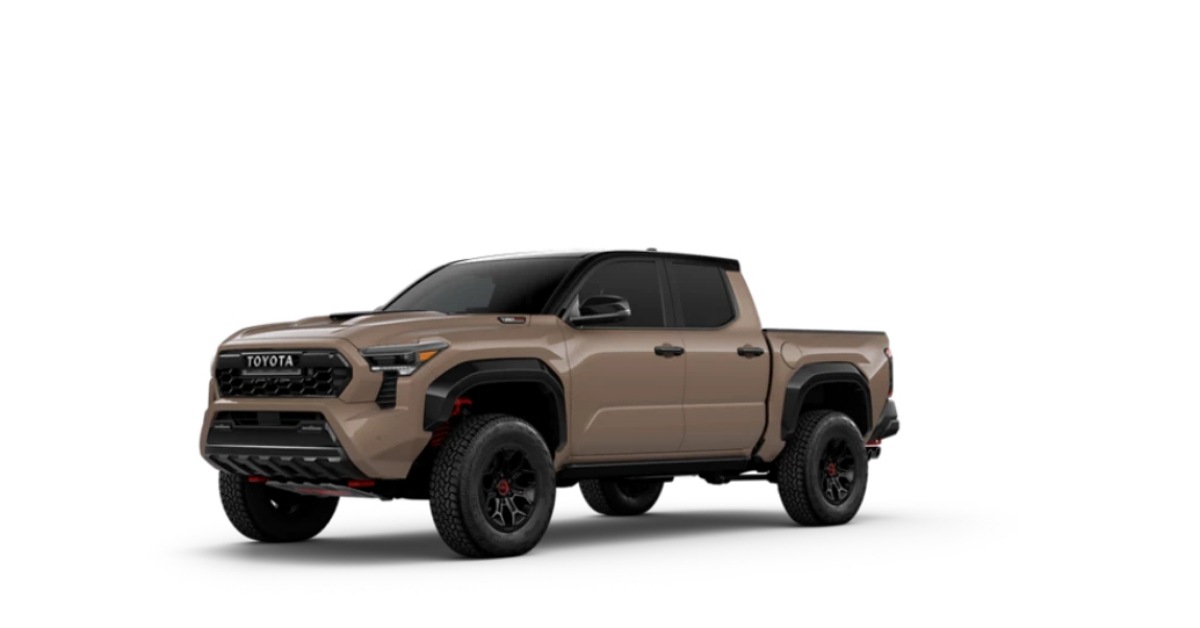
The 2025 Tacoma i-FORCE MAX takes bold design cues and translates them into a truck that looks ready for anything. The front end features an aggressive stance with a wider grille that commands attention on the road. This isn’t accidental—Toyota redesigned the truck from the ground up, and it shows.
The LED headlights are genuinely impressive, providing excellent illumination and a modern aesthetic that sets the Tacoma apart from competitors like the Honda Ridgeline and Chevrolet Colorado. These aren’t just bright; they’re smart, with adaptive beam control and automatic high-beam functionality that adds a layer of tech-forward thinking to an otherwise mechanical machine.
The body styling incorporates muscular fender lines that flow naturally from the hood down the truck’s sides. The available multiple paint options—including the bold Supersonic Red and modern Blueprint Grey—give buyers real visual choices. Wheel options range from 17 to 18-inch alloys, with TRD models sporting more aggressive designs that hint at off-road capability.
The overall road presence is commanding. This truck won’t blend into parking lots. Standing next to a Honda Ridgeline or Ford Ranger, the Tacoma feels more purposeful, more rugged, and genuinely more truck-like despite being a midsize offering. Toyota didn’t compromise design for efficiency—they created something that looks expensive without requiring a full-size price tag.
Build quality across the exterior panels is solid. Fit and finish on review units show Toyota’s commitment to the midsize market. The available Terra and Sunset paint options add distinctiveness that appeals to those who want their truck to reflect personal style.
Interior Review
Step inside the 2025 Tacoma i-FORCE MAX, and you’ll immediately notice how far Toyota has brought the cabin experience. Gone are the days of plastic-heavy, utilitarian interiors. This cabin feels genuinely modern and thoughtfully designed, though it maintains the purposeful simplicity that truck buyers appreciate.
The dashboard layout is intuitive. A redesigned infotainment system greets you with either an 8-inch touchscreen (on lower trims) or an available 14-inch display that becomes standard on Limited models. That 14-inch screen is genuinely impressive—responsive, clear, and organized in a way that doesn’t require a manual to navigate. Both Apple CarPlay and Android Auto come standard as wireless connections, making smartphone integration seamless whether you’re using iPhone or Android.
The gauge cluster ranges from a 7-inch digital display on base models to a more impressive 12.3-inch all-digital unit on TRD Off-Road and higher trims. On Premium packages, a head-up display projects critical information onto the windshield, reducing the need to glance down while driving.
Seat comfort represents a major step forward for the Tacoma. The revised seating position sits higher than previous generations, giving drivers a commanding view of the road while reducing that awkward “sitting on the floor” feeling that plagued older Tacomas. Front seats offer 6-way manual adjustment on lower trims, with 2-way power-adjustable lumbar support available. Higher trims feature the IsoDynamic Performance seats with dampening systems that actually make long road trips more comfortable—a detail that shouldn’t be overlooked.
Real owners consistently praise the heated and ventilated seats when equipped with the Premium package. One owner mentioned that during a recent road trip, the heated seats during cold mornings and ventilated seats during afternoon drives made a genuine difference in overall comfort. The SofTex upholstery resists staining better than traditional fabric, which matters when you’re loading dirty camping gear or muddy boots.
Rear seat space is a legitimate consideration. At 6 feet tall, the driver can sit comfortably up front, but rear legroom is tight when the front seat is set for an average adult. Families with children will find the rear seats adequate, but tall passengers will feel the space limitations. This is one area where competitors like the Honda Ridgeline actually provide more rear headroom and legroom.
Storage is thoughtfully integrated throughout the cabin. Door pockets, under-seat storage, and a redesigned center console provide practical places for phones, wallets, and other essentials. The optional 2400-watt/1200-volt AC power inverter on i-FORCE MAX grades means you can actually power your laptop or tools directly from the truck, adding genuine utility that goes beyond entertainment.
Climate control uses automatic temperature regulation on most trims, with tri-zone functionality available on higher models. Real-world testing shows the AC system performs well in hot climates, though there’s minimal benefit to using Eco mode for air conditioning compared to Normal mode.
Performance & Driving Experience
This is where the 2025 Tacoma i-FORCE MAX earns its stripes. The 326-hp hybrid powertrain delivers legitimate performance that makes you forget you’re driving a midsize truck, not a performance SUV. The 465 lb-ft of torque kicks in immediately thanks to that 48-hp electric motor, which provides instant low-end response before the turbocharger spools up.
In the city, the Tacoma feels responsive. The electric motor eliminates turbo lag, giving you immediate throttle response when you need it. Daily driving feels effortless, whether you’re merging on highways or navigating tight parking lots. One owner mentioned that in mixed city driving with moderate acceleration, they achieved around 22 mpg—above the EPA’s 22 city estimate. Drive it aggressively, and those numbers drop to 17-18 mpg, but that’s still respectable for a truck of this capability.
Highway performance showcases the truck’s true capability. The 8-speed automatic transmission shifts smoothly, and the truck maintains its composure at sustained speeds. Real owners consistently report hitting 24-25 mpg on flat highway stretches with cruise control engaged. That 6,500-lb towing capacity translates to real-world capability—you’re not stretching limits with a boat or utility trailer. The integrated trailer brake controller and trailer backup guide feature make towing genuinely manageable.
Sport mode is where driving fun emerges. Engaging Sport mode tightens the steering, adjusts suspension damping, and changes engine response for more spirited driving. Yes, you’ll consume more fuel, but the driving engagement increases noticeably. Acceleration feels quicker, and the truck actually feels more responsive around corners than you’d expect from a truck this size.
Engine refinement deserves special mention. The turbocharged four-cylinder with hybrid assistance doesn’t produce the traditional turbo whistle or unexpected power surges. Instead, it delivers smooth, linear power delivery that never feels abrupt or artificial. The engine is audibly present when accelerating aggressively, but it’s never loud or intrusive during normal driving.
The transmission rarely hesitates or jolts. Sequential shift mode allows manual gear selection if you want more control during off-roading or towing, but the standard automatic operation is sophisticated enough that most drivers will leave it in Drive and forget about it. The uphill and downhill shift logic actually works—the truck anticipates terrain changes and adjusts gear selection preemptively.
Braking confidence comes from the responsive brake pedal and regenerative braking system. The hybrid system captures energy during deceleration, which not only helps recharge the battery but also smooths out the braking feel. Panic stops are controlled and predictable, without the spongy sensation that sometimes affects hybrid vehicles.
The ride quality represents genuine improvement over previous Tacoma generations. Independent double-wishbone front suspension combined with a coil-spring multi-link rear creates compliance that’s surprising for a body-on-frame truck. Rough roads are handled with composure—potholes don’t jar you, and highway expansion joints don’t create harsh impacts. The available adaptive variable suspension (on Limited models) further refines this, automatically adjusting damping based on road conditions.
Off-road performance is where the Tacoma truly excels. Multi-Terrain Select offers different modes—Rock, Dirt, Sand, and Mud—that adjust throttle response, traction control, and gearing. The electronically controlled locking rear differential on TRD models provides genuine locking capability, not just electronic traction control. Crawl Control handles slow-speed rock crawling by controlling throttle automatically, allowing you to focus on steering. The front stabilizer bar disconnect on certain trims is a feature borrowed from full-size trucks—it allows the front sway bar to be electronically disabled for improved articulation on rough terrain.
Real owners taking their Tacoma i-FORCE MAX off-road report confident performance and responsive handling even on technical trails. The truck feels composed climbing over obstacles and stable descending steep grades. The standard trailer hitch and tow hooks on all trims—a first for Tacoma—add genuine versatility for recovery situations or additional load-carrying.
Features & Technology
The 2025 Tacoma i-FORCE MAX represents a significant technology upgrade for the nameplate. These aren’t frivolous features—they’re genuinely useful additions that make ownership more enjoyable.
The infotainment system starts with an 8-inch touchscreen on most models, but that optional 14-inch display on Limited and higher trims is where things get interesting. The responsiveness is excellent, loading apps and maps faster than you’d expect. The interface is logical—Toyota didn’t get creative for creativity’s sake. Your phone integrates seamlessly via Apple CarPlay or Android Auto, both now available wireless on all trims.
Toyota’s offering of a detachable JBL speaker on premium audio systems is a clever touch. This portable Bluetooth speaker literally unclips from the dashboard—perfect for trailside gatherings or playing music at camp. One owner specifically mentioned this as a favorite feature during weekend trips.
The 12.3-inch all-digital gauge cluster on TRD Off-Road and higher trims is customizable. You can display vehicle information, navigation directions, off-road performance metrics, or simply a traditional gauge layout. It’s useful without being distracting, and it adds a modern tech element to the cabin.
Toyota Safety Sense 3.0 is comprehensive—Pre-Collision System with Pedestrian Detection, Adaptive Cruise Control, Lane Departure Alert with Steering Assist, Automatic High Beams, Road Sign Assist, and Proactive Driving Assist all come standard. These aren’t gimmicks. Real owners report that adaptive cruise control performs well on long highway stretches, reducing fatigue significantly. Lane-keeping assist is unobtrusive when you’re driving well and gently suggests corrections when you drift from lane markings.
Connectivity features on Premium packages include a head-up display, wireless phone charging, and remote climate control capabilities. The available 120V power outlet in the bed (on i-FORCE MAX grades) actually works well for powering tools or charging equipment at worksites or campsites.
The panoramic view monitor is a practical off-road feature that provides a 360-degree camera view when needed. This helps tremendously when navigating tight rocky areas or parking in crowded spots. It’s not essential, but once you’ve used it, you’ll understand why Toyota included it.
Safety Review
The 2025 Toyota Tacoma is taking safety seriously. While the NHTSA hasn’t completed full testing on the 2025 model, the 2024 model received a Top Safety Pick award from the Insurance Institute for Highway Safety (IIHS). Real-world crash protection comes from extensive airbag placement—dual front, side seat mounted, and curtain airbags for both rows.
Active safety starts with Toyota Safety Sense 3.0. The Pre-Collision System uses radar and cameras to monitor traffic ahead, providing warnings if an impact is imminent and automatically applying brakes if the driver doesn’t respond. Pedestrian detection extends this protection to vulnerable road users. In real-world driving, owners report that the system provides helpful warnings without constant false alarms—a balance many systems struggle to achieve.
Full-Speed Range Dynamic Radar Cruise Control maintains set distance from vehicles ahead, even in stop-and-go traffic. It’s not perfect in every situation, but it’s genuinely useful for highway driving and reduces driver fatigue. Lane-keeping assist and lane-tracing assist work together to keep the truck centered in its lane and provide gentle steering corrections if you drift. These systems are unobtrusive unless you need them, which is exactly how driver assistance should work.
Anti-lock braking, electronic brake force distribution, and stability control are standard. The electronic parking brake is a modern touch that reduces cabin clutter compared to traditional parking brake levers. Backup Guide Monitor helps during reversing, projecting steering lines on the available backup camera display.
Blind Spot Monitor with Rear Cross-Traffic Alert comes available and is genuinely useful when backing out of parking spots or changing lanes. The system provides both visual and audible warnings, which real owners report as helpful without being annoying.
The truck’s body structure is designed around safety. The independent front suspension absorbs impacts better than older solid-axle designs, and the modern crumple zones are engineered to absorb collision energy while maintaining cabin integrity.
Mileage & Fuel Efficiency
The 2025 Tacoma i-FORCE MAX claims EPA ratings of 22 city / 24 highway / 23 combined mpg. In real-world testing, these numbers are achievable and sometimes beatable.
Highway driving consistently produces 24-25 mpg on flat terrain with cruise control engaged. One owner reported consistently hitting above the EPA estimate on highway runs—25-25 mpg range—which is genuinely impressive for a truck producing 326 hp. Eco mode helps on extended highway stretches by adjusting throttle response and throttle down engine aggressiveness.
City driving reality is closer to EPA estimates, ranging from 20-22 mpg depending on driving style. Stop-and-go traffic, frequent acceleration, and aggressive driving drop this to 17-18 mpg. The difference between aggressive driving and moderate driving is substantial—respecting the throttle directly translates to fuel savings.
Real owners report that break-in periods matter. After the first few thousand miles, fuel economy improves as engine components settle. The hybrid system isn’t a full hybrid like a Prius—it doesn’t drive on electric power alone, so don’t expect dramatic electric-only ranges. Instead, the electric motor supplements the turbocharged engine, improving efficiency overall.
Driving mode selection impacts efficiency. Normal mode is adequate for most driving. Eco mode reduces climate control aggressiveness and adjusts throttle response, but the difference between Normal and Eco modes is marginal—maybe a 0.5-1 mpg advantage. Sport mode, conversely, noticeably reduces economy, dropping from 23 combined to potentially 19-20 combined in mixed driving.
The 18.2-gallon fuel tank provides approximately 420 miles of range at EPA combined estimates. Real-world range ranges from 380 miles in city-heavy driving to 450+ miles on highway-focused trips. The tank size is slightly smaller than some competitors, but it’s adequate for typical driving patterns.
Price & Variant Details
The 2025 Toyota Tacoma i-FORCE MAX comes in multiple trims, with hybrid versions starting at $46,320 for the TRD Sport i-FORCE MAX. The pricing ladder provides genuine value options across the lineup.
i-FORCE MAX Trim Pricing (Starting MSRP)
- TRD Sport i-FORCE MAX: $46,320
- TRD Off-Road i-FORCE MAX: $46,620
- Limited i-FORCE MAX: $55,880
- TRD Pro i-FORCE MAX: $63,735
Standard gasoline i-FORCE models are available at lower price points for budget-conscious buyers, but the hybrid premium—roughly $2,000-3,000 extra—pays for itself through fuel savings within 100,000+ miles of typical driving.
Best Value Recommendation
The TRD Sport i-FORCE MAX offers the best value-for-money proposition. You get the hybrid powertrain advantage, basic off-road features, and modern technology without paying for unnecessary luxury features. At $46,320, it includes 4-wheel drive, TRD-tuned suspension, 18-inch wheels, and entry-level technology like an 8-inch touchscreen and Apple CarPlay.
For off-road focused buyers, the TRD Off-Road i-FORCE MAX ($46,620) adds an electronically controlled locking rear differential—a feature that dramatically improves trail performance. For an additional $300, this upgrade is essentially a must-have if you plan any serious off-road adventures.
The Limited i-FORCE MAX ($55,880) adds genuine luxury elements—heated and ventilated seats, adaptive variable suspension, head-up display, and a 14-inch touchscreen. At this price point, you’re paying for comfort rather than capability.
The TRD Pro i-FORCE MAX ($63,735) tops the range with premium features, off-road enhancements like Fox adaptive shocks, electronic locking differentials front and rear, and distinctive styling. It’s essentially the full-featured variant, but the price approaches full-size truck territory.
Most Cost-Effective Choice
The TRD Sport i-FORCE MAX represents the best bang for your buck, especially if you plan to accessorize further or if you want the hybrid efficiency and performance without paying for features you won’t use.
Pros & Cons
Pros
The hybrid powertrain is genuinely impressive. 326 hp and 465 lb-ft of torque make this truck feel quicker than competitors, and the fuel economy doesn’t suffer. Real owners report genuine satisfaction with the power delivery—it’s responsive, linear, and never feels artificial.
Towing capacity of up to 6,500 lbs is legitimate. With the included trailer backup guide and brake controller, hauling trailers feels manageable. The truck maintains composure under load, and the transmission doesn’t struggle.
Off-road capability is impressive. Multi-terrain select, crawl control, and locking differentials provide genuine functionality for trail driving. The truck doesn’t just pretend to be off-road capable—it actually is, with tech features that justify the midsize positioning.
Interior quality represents a massive upgrade from previous generations. Soft-touch materials, intuitive layout, and modern technology make the cabin feel premium without feeling pretentious. The design is functional first, aesthetic second—which is exactly what truck buyers want.
Fuel efficiency for a truck producing this much power is legitimate. 22-24 mpg is genuinely impressive for a truck with 465 lb-ft of torque. Highway driving regularly beats EPA estimates.
Safety features are comprehensive and actually useful. Toyota Safety Sense 3.0 provides genuine value, and features like blind-spot monitoring actually work without false alarms.
Ride quality is composed and refined. The independent front suspension combined with adaptive components creates a truck that doesn’t feel like you’re constantly battling potholes.
Cons
Rear seat space is genuinely tight. For tall adults, sitting behind another tall adult becomes uncomfortable on road trips. Families with teenagers will notice this limitation.
The fuel tank is relatively small at 18.2 gallons. While it provides adequate range, it means more frequent fill-ups on extended road trips compared to full-size trucks.
Real-world fuel economy can vary significantly from EPA estimates depending on driving conditions and personal driving style. Aggressive drivers will see 17-18 mpg consistently, which limits the hybrid advantage.
The truck’s base price is higher than non-hybrid competitors. While you recover this premium through fuel savings, the initial out-of-pocket cost is higher upfront.
Turning radius with the longer bed configuration is legitimately difficult. Tight parking lots and urban driving can be challenging compared to more maneuverable midsize trucks.
Some owners report touchy sensors during reversing, with overly sensitive proximity warnings. This is more annoying than dangerous but worth noting.
Dealer availability of certain colors and configurations can mean waiting for vehicles to be built rather than buying off the lot, particularly for popular combinations.
Competitors Comparison
The 2025 Tacoma i-FORCE MAX doesn’t exist in a vacuum. Comparing it to other midsize offerings provides perspective on its actual value and capabilities.
| Feature | Tacoma i-FORCE MAX | Honda Ridgeline | Chevy Colorado |
|---|---|---|---|
| Horsepower | 326 hp | 280 hp | 310 hp (turbo) |
| Torque | 465 lb-ft | 262 lb-ft | 348 lb-ft (turbo) |
| Towing Capacity | 6,500 lbs | 5,000 lbs | 6,600 lbs |
| EPA Combined MPG | 23 mpg | 24 mpg | 21 mpg (turbo) |
| Price (Starting) | $46,320 | $49,950 | $42,500 |
| Transmission | 8-speed Auto | 9-speed Auto | 8-speed Auto |
| All-Wheel Drive | Optional (4WD) | Standard | Optional |
| Off-Road Features | Multi-terrain, Crawl, Locking Diff | Road-focused, No ADAS modes | Multi-terrain available |
| Interior Tech | 14″ touchscreen (opt) | 9″ touchscreen | 8″ touchscreen |
| Bed Style | Steel | Composite | Steel |
vs. Honda Ridgeline
The Ridgeline prioritizes on-road comfort and everyday usability. With standard all-wheel drive and a more comfortable cabin, it’s the choice for drivers who want a truck but prioritize luxury sedan-like driving dynamics. However, the Tacoma i-FORCE MAX delivers significantly more power (326 vs 280 hp), greater towing capacity (6,500 vs 5,000 lbs), and more comprehensive off-road features. If adventure is your priority, the Tacoma wins. If daily comfort is paramount, the Ridgeline has advantages.
vs. Chevy Colorado
The Colorado offers slightly higher towing capacity (6,600 lbs) and lower starting price, but the Tacoma i-FORCE MAX delivers superior horsepower (326 vs 310) and torque (465 vs 348 lb-ft). The Tacoma’s hybrid system provides better fuel economy (23 vs 21 combined) and more sophisticated technology. Real-world reliability data slightly favors Toyota, though both are competent trucks. The Colorado feels more utilitarian, while the Tacoma feels more refined.
vs. Ford Ranger
The Ranger is genuinely capable, but without a hybrid option in the midsize lineup, it can’t match the Tacoma’s efficiency and power combination. The Tacoma i-FORCE MAX delivers more torque and significantly better fuel economy. Price-wise, the Ranger is competitive, but the Tacoma’s overall package edges ahead.
Final Verdict
The 2025 Toyota Tacoma i-FORCE MAX represents genuine progress for the midsize truck segment. This isn’t a truck that compromises—it delivers impressive power, legitimate fuel efficiency, capable off-road features, and refined everyday usability in one competent package.
Should You Buy It?
The Tacoma i-FORCE MAX is perfect for buyers who want genuine truck capability without full-size truck drawbacks. If you value off-road performance, appreciate modern technology, and want respectable fuel economy without sacrificing power, this truck delivers.
Real owners consistently report high satisfaction. They appreciate the responsive powertrain, capable off-road features, and genuinely useful technology. The interior quality surprises owners coming from older trucks, and the fuel economy exceeds expectations when driven moderately.
The truck isn’t for everyone. If you need maximum towing capacity, the full-size Tundra is your truck. If you prioritize on-road comfort and daily usability, the Honda Ridgeline is arguably more refined. But for the overlapping middle ground—buyers who want genuine capability plus everyday refinement—the Tacoma i-FORCE MAX is genuinely compelling.
Best For
The 2025 Tacoma i-FORCE MAX is best for weekend adventurers who want a truck that handles trails confidently, daily commuters who value fuel efficiency, and truck buyers who appreciate technology without feeling like they’re piloting a spaceship. It’s perfect for those transitioning from full-size trucks who realize they don’t need that much size or complexity.
Skip It If
You need maximum towing capacity (full-size Tundra is better), prioritize on-road luxury comfort (Ridgeline is more comfortable), or have a strict budget and don’t value the hybrid powertrain premium.
Frequently Asked Questions
Is the 2025 Tacoma i-FORCE MAX good for families?
Yes, the Tacoma works well for family trips on highways and even light off-road adventures. The main limitation is rear seat space for tall passengers. Families with teenagers or parents might find rear legroom tight on long road trips. Front seats are genuinely comfortable, and climate control features like heated and ventilated seats add real comfort.
What is the real-world fuel mileage?
EPA estimates are 22 city / 24 highway / 23 combined. In actual driving, expect 20-22 mpg in mixed city driving with normal driving habits, and 24-25 mpg on flat highway stretches with cruise control. Aggressive driving drops to 17-18 mpg. Highway driving often exceeds EPA estimates, which is good news.
What is the maintenance cost?
Toyota includes ToyotaCare—a comprehensive maintenance plan covering 2 years or 25,000 miles, whichever comes first. Scheduled maintenance is covered, and 24-hour roadside assistance is included for unlimited miles during that period. After this period, maintenance costs are typical for a quality truck—similar to Honda Ridgeline or Chevy Colorado. Oil changes, tire rotations, and fluid services are affordable. Hybrid-specific maintenance is minimal since the system is robust and proven.
Can the Tacoma handle serious off-roading?
Absolutely. The multi-terrain select, crawl control, locking differential, and independent front suspension make this truck genuinely capable. It won’t match a Jeep Wrangler in extreme situations, but for typical off-road adventures—rocky trails, sand, mud, snow—it’s more than capable. Real owners taking their trucks on serious trails report confident performance.
How does the towing capacity work?
6,500 lbs is the rated capacity with proper equipment. This means utility trailers, boat trailers, and small travel trailers are manageable. The integrated trailer brake controller helps with stopping, and the panoramic camera system assists with backing up. Always verify tongue weight distribution and use proper hitching equipment.
Is the hybrid system reliable?
The i-FORCE MAX system is Toyota’s first hybrid truck engine, but it’s built on proven hybrid technology from the RAV4 and other models. Early reports show no reliability issues, and Toyota’s warranty covers hybrid-specific components for 8 years/100,000 miles. The simpler hybrid design compared to Prius means fewer moving parts and less potential trouble.
What’s the difference between the TRD Sport and TRD Off-Road?
For essentially $300 more, the TRD Off-Road adds an electronically controlled locking rear differential—a feature that dramatically improves off-road capability. If you plan any serious trail driving, this upgrade is essentially mandatory. If you’re primarily highway and light trail driving, TRD Sport is adequate.
Final Thoughts
The 2025 Toyota Tacoma i-FORCE MAX emerges as a genuinely competent midsize truck that doesn’t compromise between capability, efficiency, and everyday refinement. It represents the future of truck design—powerful, efficient, and technology-focused without feeling overly complicated.
Would we buy it again? Real owners consistently say yes. This truck makes sense for modern truck buyers who appreciate value, capability, and efficiency. Toyota has finally brought the Tacoma into the current decade while maintaining its reputation for reliability.