Discover the complete 2025 Toyota 4Runner review—explore its bold design, advanced features, real-world performance, safety, mileage, and pricing to see if it’s the right SUV for you.
2025 Toyota 4Runner Review: The Ultimate Off-Road Evolution
The all-new 2025 Toyota 4Runner represents a significant leap forward for one of America’s most beloved off-road SUVs. After waiting 15 years for a complete redesign, Toyota has delivered a modern, capable adventure machine that balances its legendary ruggedness with contemporary refinement, improved fuel efficiency, and cutting-edge technology.
Key Specifications at a Glance
The sixth-generation 4Runner arrives with two powerful engine options that mark a departure from the aging V6 of previous generations. The standard i-FORCE turbocharged 2.4-liter inline-four engine delivers 278 horsepower at 6,000 rpm and 317 lb-ft of torque at 1,700 rpm. For those seeking more power, the available i-FORCE MAX hybrid system combines that same turbocharged engine with a 48-horsepower electric motor and 1.87 kWh nickel-metal hydride battery, producing a combined 326 horsepower and an impressive 465 lb-ft of torque.
Both powertrains pair with an eight-speed automatic transmission—a massive improvement over the outdated five-speed automatic from the previous generation. The 4Runner maintains its maximum towing capacity of 6,000 pounds, representing a 1,000-pound improvement over its predecessor. Fuel economy varies by configuration, with rear-wheel-drive gas models achieving 20 city/26 highway/22 combined MPG, four-wheel-drive versions getting 19 city/25 highway/21 combined, and hybrid variants earning 23 city/24 highway/23 combined MPG.
Exterior Design: Muscular and Modern
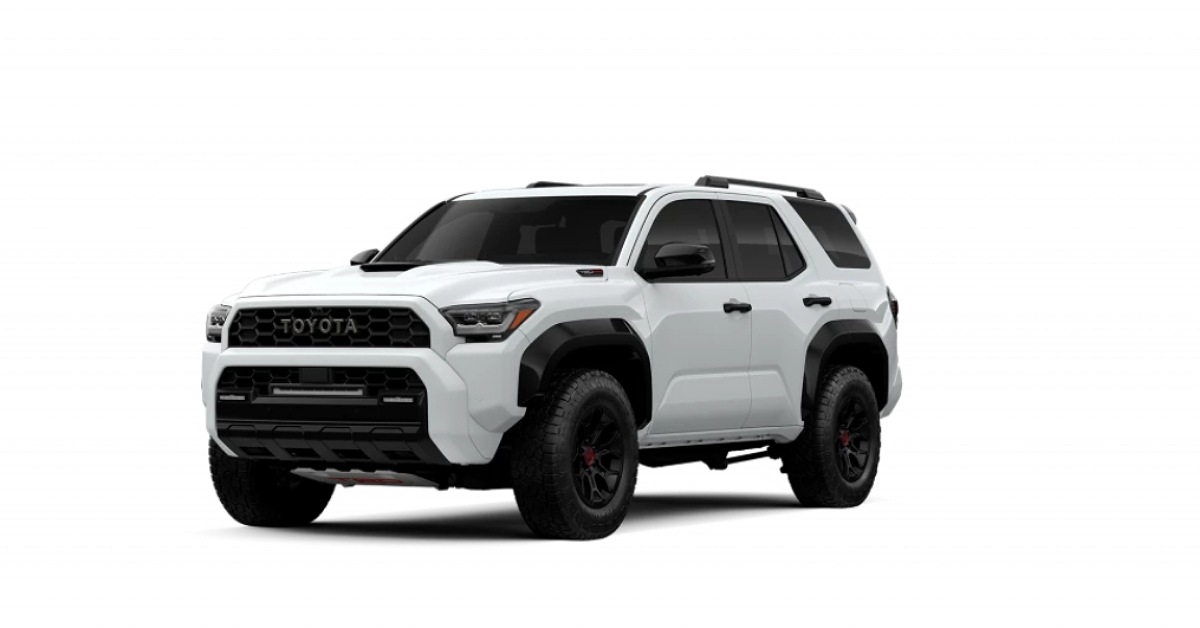
The 2025 4Runner showcases a bold, muscular stance that honors its heritage while embracing modern design language. The front fascia features a high-set, flattish hood with prominently mounted headlamps and integrated daytime running lights. A wide, commanding grille sits at the center, while horizontal Rigid LED fog lamps provide an assertive appearance.
The new 4Runner rides on Toyota’s robust TNGA-F global truck platform—the same foundation used for the Tacoma, Tundra, Land Cruiser, and Sequoia. This platform incorporates a high-strength boxed steel-ladder frame with double-wishbone front suspension and multi-link coil rear suspension, delivering enhanced ride comfort and on-road manners while maintaining exceptional off-road capability.
Ground clearance ranges from 8.1 inches on the base SR5 to an impressive 10.1 inches on the TRD Pro and Trailhunter models. Approach angles span from 18 degrees on lower trims up to 33 degrees on top-tier off-road variants, with breakover angles of 24 degrees and departure angles reaching 24 degrees on serious off-road trims.
The 4Runner is available in multiple striking exterior colors including Ice Cap, Black, Underground, Celestial Silver Metallic, Supersonic Red, Wind Chill Pearl, Cutting Edge, Heritage Blue, Everest, and Mudbath. TRD Pro and Trailhunter models feature additional exclusive colors like Solar Octane, Bronze Oxide, Electric Lime, Lunar Rock, and Blue Crush.
Interior: A Quantum Leap in Quality and Technology
The cabin of the 2025 4Runner represents perhaps the most dramatic improvement over the outgoing model. The interior draws heavily from the Tacoma’s design, featuring a modern, driver-focused layout with premium materials and thoughtful ergonomics.
Most trims receive a 12.3-inch digital instrument display paired with a 14.0-inch center touchscreen infotainment system, though base models come with 7.0- and 8.0-inch units respectively. Both systems feature wireless Apple CarPlay and Android Auto compatibility. Higher trims offer amenities like a head-up display, Qi wireless charging with increased power output, USB-C ports front and rear, and shareable Digital Key functionality.
Seating options range from durable cloth on the SR5 to SofTex synthetic leather on mid-level trims and premium leather on the Platinum grade. Available features include heated and ventilated front seats, heated second-row seats on select trims, and dual-zone automatic climate control. Select models offer a premium JBL audio system, with the Trailhunter featuring a unique JBL FLEX portable speaker that docks on the dashboard as a center channel or operates independently on battery power.
The 4Runner accommodates five passengers as standard, with an optional third-row available on SR5 and Limited trims for seven-passenger capacity. However, hybrid models cannot be equipped with third-row seating due to the battery pack’s placement under the load floor. Cargo space measures 48.4 cubic feet behind the second row and 90.2 cubic feet with rear seats folded in gas models, while hybrid versions offer 42.6 and 82.6 cubic feet respectively.
Storage solutions include multiple cubbies, cup holders, and thoughtfully placed compartments throughout the cabin. The classic power-retractable rear window remains a signature feature, and an available hands-free power liftgate adds convenience.
Performance and Driving Experience: Power Meets Refinement
On-road performance marks a significant improvement over previous generations. The new turbocharged engine provides strong low-end torque thanks to peak torque arriving at just 1,700 rpm, making city driving and highway merging confident operations. Our testing revealed the four-wheel-drive 4Runner reaches 60 mph in 7.5 seconds—only marginally quicker than the old V6 but with notably better responsiveness throughout the power band.
The eight-speed automatic transmission shifts crisply and intelligently, a night-and-day improvement over the sluggish five-speed it replaces. Multiple drive modes allow customization for various conditions, including Normal, Eco, Sport, and terrain-specific settings.
Off-road capability remains exceptional, with part-time and full-time four-wheel-drive systems available depending on trim. An electronically controlled two-speed transfer case with high and low range comes standard on 4WD configurations. Advanced off-road features include Active Traction Control (A-TRAC), automatic limited-slip differential (Auto LSD), Multi-Terrain Select system, CRAWL Control for low-speed rock crawling, Downhill Assist Control, and Multi-Terrain Monitor.
Select trims feature a disconnecting stabilizer bar system for improved articulation on technical terrain, while TRD Off-Road, TRD Pro, and Trailhunter grades include an electronic locking rear differential. The TRD Pro equips FOX QS3 shocks with manually-selectable three-setting damping for desert running and high-speed off-road performance, while the Trailhunter uses ARB Old Man Emu shocks tuned for overlanding and load-carrying capability.
Real-world fuel economy for hybrid models averages around 21 mpg combined over diverse driving conditions, slightly below the EPA estimate of 23 mpg. Highway driving can achieve closer to the 24 mpg highway rating, while city driving benefits most from the hybrid system’s electric assist.
Features and Technology: Safety First, Adventure Always
Toyota equips every 2025 4Runner with Toyota Safety Sense 3.0, a comprehensive suite of driver-assistance technologies. Standard features include Pre-Collision System with Pedestrian Detection, Lane Departure Alert with Steering Assist, Lane Tracing Assist, Road Sign Assist, Automatic High Beams, and Dynamic Radar Cruise Control.
Blind Spot Monitor with Rear Cross-Traffic Alert comes standard across all trims—a feature competitors often reserve for higher trim levels. The available 360-degree camera system with Multi-Terrain Monitor provides exceptional visibility for navigating tight trails or urban parking situations.
Additional convenience features vary by trim but can include adaptive variable suspension, stop-start engine system, automatic running boards that deploy when doors open, fixed running boards, or frame-mounted rock rails depending on the chosen grade.
Safety: Built to Protect
The 2025 4Runner is designed with comprehensive passive and active safety systems. All models include eight airbags covering driver, front passenger, knee airbags, and full-curtain coverage for all three rows when equipped.
The Insurance Institute for Highway Safety (IIHS) tested the 2025 4Runner and awarded it an overall “Marginal” rating in the updated moderate overlap front crash test. The structure and safety cage earned “Good” ratings, with driver injury measures scoring “Good” for head/neck, chest, and hip/thigh, and “Acceptable” for leg/foot. However, rear passenger lap belt positioning moved from the ideal position on the pelvis onto the abdomen during testing, increasing abdominal injury risk.
The National Highway Traffic Safety Administration (NHTSA) has selected the 2025 4Runner for its 5-Star Safety Ratings program testing, though final ratings were not available at the time of this review.
Price and Variant Breakdown: Options for Every Adventure
The 2025 Toyota 4Runner starts at an MSRP of $42,765 for the base SR5 trim and extends to $68,350 for the range-topping Trailhunter. Here’s the complete pricing structure:
Gas Engine Trims:
- SR5: $42,765
- TRD Sport: $49,245
- TRD Sport Premium: Starting around $52,610
- TRD Off-Road: $49,190
- TRD Off-Road Premium: Starting around $54,970
- Limited: $55,400 (gas), $60,200 (hybrid)
Hybrid-Exclusive Trims:
- TRD Off-Road i-Force Max: $51,990
- TRD Off-Road Premium i-Force Max: $57,770
- Limited i-Force Max: $60,200
- Platinum: $62,860
- TRD Pro: Starting around $67,000
- Trailhunter: $68,350
All prices exclude the $1,450 destination charge.
Best Value Recommendations:
For budget-conscious buyers seeking core 4Runner capability, the SR5 delivers exceptional value at $42,765, including heated cloth seats, Toyota Safety Sense 3.0, and genuine off-road ability. The TRD Off-Road Premium with the optional hybrid system represents the sweet spot for many buyers, combining serious off-road hardware, the powerful hybrid powertrain, enhanced interior features, and the larger 14-inch touchscreen at a price point below $