Read our complete 2026 Toyota Corolla Hybrid review—explore its exceptional fuel economy, safety features, pricing, and real-world performance. Find out if it’s the right hybrid for you.
Introduction
The 2026 Toyota Corolla Hybrid arrives as one of the most sensible choices in the compact sedan segment, combining practical engineering with exceptional fuel efficiency that actually translates to real savings at the pump. Launched to meet the growing demand for affordable hybrid vehicles, this latest Corolla Hybrid generation proves that you don’t need to break the bank to drive a fuel-efficient daily companion. The standout feature here is the impressive fuel economy—reaching up to 50 miles per gallon combined for front-wheel-drive models—making it a magnet for cost-conscious drivers who commute regularly. With hybrid technology that has proven itself across multiple Toyota generations since 2016, this sedan delivers reliability alongside affordability, a combination that’s becoming increasingly rare in today’s automotive market.
Key Specifications
Engine: 1.8-liter 4-cylinder hybrid with Atkinson cycle technology
Horsepower: 138 hp combined system output
Torque: 105 lb-ft
Transmission: Electronically controlled continuously variable transmission (e-CVT)
Drive Type: Front-wheel drive standard; all-wheel drive available on select trims
Fuel Economy (FWD): 53 city / 46 highway / 50 combined mpg
Fuel Economy (AWD): 50 city / 43 highway / 47 combined mpg
Fuel Tank Capacity: 11.3 gallons (43 liters)
Estimated Range: 550-600 miles on a full tank
Seating Capacity: 5 passengers
Cargo Space: 13.1 cubic feet
Curb Weight: 2,850 lbs (FWD)
Length: 182.5 inches
Width: 70.1 inches
Height: 56.5 inches
Wheelbase: 106.3 inches
Ground Clearance: 5.3 inches
Turning Circle: 35.6 feet
Warranty: 3 years / 36,000 miles basic coverage
Exterior Design Review
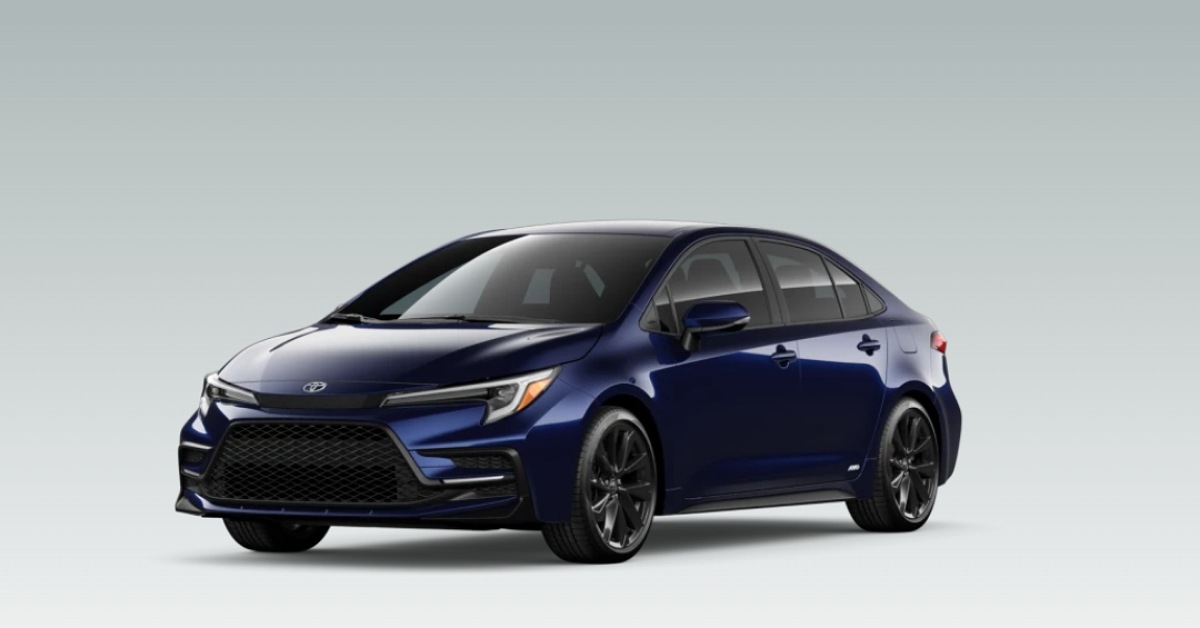
The 2026 Corolla Hybrid displays a refined approach to compact sedan styling that strikes a balance between maturity and contemporary appeal. The front fascia features a modernized grille design flanked by updated LED headlights that provide improved visibility and a more premium appearance compared to previous generations. The headlight design incorporates a sleek signature that stretches across the front, giving the Corolla Hybrid a wider, more confident stance than you’d expect from an economy sedan.
Along the side profile, the car showcases clean body lines that flow smoothly from the front fender through to the rear quarter panel, an intentional design choice that enhances aerodynamic efficiency while maintaining visual interest. This sculpted approach helps reduce drag, which directly benefits fuel economy—something engineers clearly prioritized when shaping this generation. The alloy wheel options available across different trim levels range from practical designs on base models to more sophisticated multi-spoke patterns on higher trims.
The rear end presentation keeps things straightforward with horizontal taillights and a clean bumper design, avoiding unnecessary complexity. The overall color palette remains traditional, with standard metallic options including classic Toyota Silver, Pearl White, and Magnetic Gray, all chosen to complement the car’s refined appearance. For a compact sedan segment where many competitors push bold styling at the expense of practicality, the Corolla Hybrid’s measured approach feels appropriately confident without attempting to masquerade as something it isn’t.
Build quality feels solid across the exterior panels, with consistent gap tolerances and responsive door seals that suggest attention to manufacturing standards. The compact dimensions make this car genuinely easy to maneuver in tight urban environments and park in crowded lots—a real advantage for daily city driving that shouldn’t be overlooked.
Interior Review
Step inside the 2026 Corolla Hybrid and you’re greeted with a cabin that prioritizes functionality over flash, a philosophy that makes sense for a value-focused hybrid. The dashboard layout remains straightforward, with clearly labeled controls and an intuitive arrangement that doesn’t require a manual to figure out. Materials throughout the cabin have received subtle upgrades from previous generations, with improved touchpoints and a cleaner overall aesthetic that elevates the cabin experience without inflating costs.
The driver’s seat provides adequate support for extended commutes, and seat adjustment ranges prove generous enough for drivers of various heights to find a comfortable position. Manual seat adjustments come standard on base models, while higher trims upgrade to power-adjustable driver’s seats—a welcome convenience on models like the XLE trim where the additional comfort features justify the premium investment.
Rear passenger space accommodates five adults reasonably well, with sufficient legroom for typical adults to sit without complaint on moderate-length trips. The back seat feels roomy enough for business colleagues during carpools or family members on weekend drives. Shoulder room ranks adequate though not expansive, a natural trade-off in the compact sedan segment.
The trunk opening presents a practical design with low load height, making it easier to load groceries, luggage, or equipment without straining your back. The 13.1 cubic feet of cargo capacity handles weekend getaway duties or regular shopping trips without issues, though large furniture or multiple suitcases may require strategic packing.
Climate control functions appear on all models, with base trims offering single-zone operation and higher models receiving dual-zone capability. The system responds quickly and maintains temperature effectively without excessive noise. Air filtration systems keep cabin air clean, a particularly valuable feature in areas prone to poor air quality or pollen seasons.
Storage compartments throughout the cabin provide reasonable space for phones, small belongings, and the miscellaneous items that accumulate during daily driving. Cup holders sit conveniently positioned for both front passengers, and door pockets offer additional organization options.
Performance & Driving Experience
The 2026 Corolla Hybrid delivers city driving that feels composed and manageable, exactly what you’d want from a compact sedan designed for regular commuting. The 1.8-liter engine combines with the hybrid system to produce 138 horsepower—not particularly aggressive on paper, but adequate in practice for navigating urban traffic and merging onto highways. The electronic continuously variable transmission manages engine loading intelligently, stepping in with increased power when needed and retreating to efficient operation during steady-state driving.
On highway drives at steady speeds, the Corolla Hybrid settles into a comfortable rhythm with highway fuel economy approaching 46 miles per gallon when conditions cooperate. The transmission logic decides intelligently whether to engage the electric motor or rely on gasoline power, generally making sensible trade-offs between performance and efficiency without requiring driver intervention. Hill-start assist control engages automatically on inclines, preventing the car from creeping backward and adding a layer of safety and convenience during stop-and-go traffic.
Acceleration feels adequate rather than thrilling, with zero-to-60 mph acceleration landing in the mid-8 second range—perfectly serviceable for a fuel-efficient hybrid but not particularly exciting if you appreciate spirited driving. The hybrid system manages to deliver responsive power during moderate acceleration, with the electric motor providing immediate torque that makes city driving feel less sluggish than the horsepower figures suggest.
Engine refinement receives praise across real-world testing, with the Atkinson cycle design providing smooth operation and minimal vibration transmission into the cabin. The CVT transmission eliminates the gear-hunting behavior that plagued earlier continuously variable transmissions, instead functioning with natural power delivery that feels more like a conventional automatic—a significant step forward for Toyota’s hybrid engineering.
Independent MacPherson strut front suspension combined with a stabilizer bar manages typical road imperfections capably, striking a balance between comfort and responsiveness. Steering feel remains responsive without sacrificing accuracy, making the Corolla Hybrid predictable and confidence-inspiring during evasive maneuvers or emergency braking situations.
Features & Technology
The 2026 Corolla Hybrid arrives equipped with practical technology appropriate for its market position, avoiding unnecessary complexity while maintaining connectivity and entertainment value. The infotainment system comes standard with an 8-inch touchscreen display that supports both Apple CarPlay and Android Auto, allowing seamless smartphone integration for navigation, music streaming, and hands-free calling. The interface responds reasonably quickly to inputs and maintains a clean menu structure that doesn’t require excessive scrolling to reach common functions.
Available on higher trims is an upgrade to a 10.5-inch display with Toyota’s latest software, which improves responsiveness and visual clarity. A 12.3-inch digital gauge cluster option provides a customizable driver display showing vehicle information, fuel economy data, and navigation guidance directly in the driver’s line of sight.
Audio and cruise control functions integrate into the steering wheel spokes, allowing hands-free operation of volume and speed settings—a practical safety feature during highway driving. The system includes adaptive cruise control on applicable trims, which automatically adjusts following distance from preceding vehicles and can help reduce driver fatigue during extended highway drives.
Connectivity features remain straightforward without overwhelming buyers with unnecessary options. Blind spot monitoring comes standard on many trims, providing visual alerts when vehicles enter your peripheral vision during lane changes—a simple but valuable safety feature that justifies its presence on modern vehicles.
Available wireless charging pads accommodate compatible smartphones, eliminating the need to fumble with charging cables. Rear USB ports appear on higher trim levels, ensuring that passengers can charge devices independently during longer trips.
The available premium audio system upgrades the base speaker package with additional channels and improved sound quality, though the standard system serves adequately for everyday listening. SiriusXM satellite radio availability provides options for subscribers desiring commercial-free listening across the United States.
Safety Review
The 2026 Corolla Hybrid incorporates Toyota Safety Sense 3.0 as a comprehensive driver-assistance suite designed to help prevent accidents or mitigate collision severity. Pre-collision system with pedestrian detection scans the roadway ahead and can activate emergency braking if an impact seems imminent—a feature that has proven valuable in preventing low-speed collisions and providing warnings of potential hazards.
Lane keeping assist monitors lane markings and gently guides the steering wheel back toward the center if unintended drifting occurs, particularly valuable during long highway drives when driver attention wanes. Lane centering assist takes this concept further by actively maintaining center position within the lane, functioning effectively on well-marked highways and reducing steering inputs required from the driver.
Blind spot collision avoidance assists during lane changes by monitoring adjacent lanes and providing alerts or subtle steering inputs if a vehicle occupies your intended path. Rear cross-traffic detection alerts during parking maneuvers when vehicles approach from directions that might escape notice through normal mirror observation.
Structural design emphasizes occupant protection through reinforced platforms incorporating high-tensile steel and optimized energy absorption zones. Airbags multiply across the cabin in both front and side positions, with whiplash-injury-lessening seats designed to minimize soft-tissue injuries during collision events. An energy-absorbing collapsible steering column further reduces injury risk during frontal impacts.
Braking systems incorporate ABS with electronic brakeforce distribution, preventing wheel lock-up during emergency braking while optimizing stopping force based on road conditions. Hill start assist control prevents unintended rollback on inclines—a practical safety feature during mountain driving or urban parking on slopes.
NCAP testing data demonstrates strong crashworthiness across multiple impact scenarios, with five-star ratings for side barrier protection and side pole impact tests. These results provide confidence that the Corolla Hybrid’s structure will perform adequately should collision occur.
Mileage & Fuel Efficiency
Real-world fuel economy testing confirms that the 2026 Corolla Hybrid genuinely delivers exceptional efficiency without requiring hypermiling techniques or unrealistic driving patterns. EPA-estimated ratings of 53 miles per gallon in city driving, 46 on highways, and 50 combined represent significant improvements over the non-hybrid Corolla, which achieves only 32 city, 41 highway, and 34 combined mpg.
On a full tank, the Corolla Hybrid maintains an estimated driving range of approximately 550 to 600 miles under mixed driving conditions—exceptional for a compact sedan that doesn’t require plug-in charging or alternative fuels. This extended range provides real convenience by reducing fill-up frequency compared to conventional gasoline vehicles.
Real-world testing conducted by various automotive publications confirms that actual fuel economy closely tracks EPA estimates under normal driving conditions. Highway driving at steady speeds has yielded results approaching the 46 mpg highway rating, while typical city driving produces results near the 53 mpg city estimate. The hybrid system’s intelligence in managing power distribution means that conservative drivers consistently exceed rated fuel economy while aggressive drivers might fall slightly short.
City versus highway mileage comparisons reveal the expected pattern where stop-and-go urban driving maximizes electric motor utilization, capturing regenerative braking energy and minimizing engine operation. Extended highway driving at steady speeds relies more heavily on gasoline power, though the efficient Atkinson cycle engine and CVT transmission maintain impressive fuel consumption regardless of speed within reasonable ranges.
Climate control usage, traffic patterns, and personal driving habits naturally influence actual fuel economy results. Aggressive acceleration, frequent hard braking, and highway speeds above 65 mph incrementally reduce fuel economy. Conversely, smooth acceleration, gentle braking, and highway speeds at or below 60 mph can push fuel economy toward the higher end of the spectrum.
Price & Variant Details
The 2026 Toyota Corolla Hybrid arrives with a starting price of $24,575 for the LE 4-door sedan with front-wheel drive, representing excellent value in the compact hybrid segment. This base pricing includes standard safety features, eight-inch infotainment display, and climate control—a complete package that doesn’t require options to deliver functionality.
Available variants break down across three primary trim levels, each with specific feature bundles and pricing implications. The LE trim provides the foundation with core comfort and safety equipment, representing the best value-for-money option for buyers prioritizing efficiency and affordability without unnecessary luxury touches. Moving to the SE trim ($27,015) introduces sport-themed styling elements including sport front seats with enhanced side bolstering and chrome interior accents that add visual interest without breaking the budget.
The XLE trim ($28,940) rounds out the lineup with the most comprehensive feature set, including synthetic leather seats, heated front seating, power driver’s seat adjustment, leather-wrapped steering wheel, and upgraded interior materials that elevate the overall ambiance. The price premium justifies itself through multiple comfort improvements and aesthetic refinements that make longer commutes more enjoyable.
All-wheel drive availability on LE and SE trims adds $1,400-$1,500 depending on specific configuration, incorporating an additional electric motor at the rear wheels to provide traction when the front wheels lose grip. This option proves valuable for regions experiencing winter weather or drivers encountering regular challenging road conditions.
Destination and handling charges, typically around $1,160, push final purchase prices higher than base MSRP figures. Regional taxes and dealer-specific markups may further influence actual out-of-pocket costs, so investigating local pricing before negotiating remains important.
Recent real-world transaction data shows average prices paid approximately 5% below MSRP, suggesting that negotiation and incentive programs currently make the Corolla Hybrid even more affordable than sticker prices indicate.
Pros & Cons
Pros:
- Exceptional fuel economy with EPA estimates reaching 50 mpg combined for FWD models—among the best in the segment
- Affordable starting price of just $24,575 makes hybrid technology accessible to cost-conscious buyers
- Proven hybrid technology dating back to 2016 Prius generation with track record of reliability and longevity
- Excellent driving range of 550-600 miles on a single tank reduces fill-up frequency
- Comprehensive safety features including Toyota Safety Sense 3.0 standard on all models
- Straightforward, intuitive interface for infotainment and climate controls
- Available all-wheel drive provides winter weather confidence without requiring premium pricing
- Quiet, refined engine operation with Atkinson cycle technology
- Reasonable cargo space adequate for weekend trips and shopping runs
- Strong resale value typical of Toyota vehicles
Cons:
- Acceleration feels modest compared to conventional sedans and some competing hybrid models—zero-to-60 in mid-8 seconds
- CVT transmission, though highly reliable in Toyota’s application, lacks the engaging feel of traditional automatics
- Limited cargo space compared to hatchback alternatives or compact SUVs
- Base infotainment display at 8 inches feels smaller compared to newer competitors offering 10+ inch screens
- Trunk opening somewhat narrow, potentially complicating loading of bulky items
- Limited entertainment factor for driving enthusiasts who value sporty handling
- Road noise at highway speeds slightly more apparent than in premium sedans
- Seating comfort on longer trips adequate rather than luxurious
Competitors Comparison
The 2026 Toyota Corolla Hybrid competes against established alternatives in the compact hybrid sedan segment, each bringing distinct strengths and philosophies to the table.
2026 Toyota Corolla Hybrid vs. 2026 Honda Civic Hybrid
The Honda Civic Hybrid employs a more powerful 2.0-liter Atkinson cycle engine producing 200 horsepower with 232 lb-ft torque, substantially exceeding the Corolla’s 138 hp output. This translates to noticeably quicker acceleration and more engaging driving dynamics that appeal to drivers prioritizing performance alongside efficiency. Honda achieves 50 mpg city and 47 mpg highway EPA ratings, placing it competitively with the Corolla while delivering the sportier experience through its conventional automatic transmission.
However, the Civic Hybrid commands a premium price point starting around $31,000-$32,000 depending on trim level, roughly $6,000 more than the Corolla Hybrid LE. The Civic uniquely lacks all-wheel drive availability, limiting its appeal to buyers in cold climates requiring extra traction. Toyota’s Corolla Hybrid positions itself as the more affordable and practical choice for economy-minded buyers, while the Civic attracts those valuing sportier character.
2026 Toyota Corolla Hybrid vs. 2026 Hyundai Elantra Hybrid
Hyundai’s Elantra Hybrid combines a 1.6-liter gasoline engine with electric motor assistance, producing 139 horsepower output nearly matching the Corolla’s 138 hp despite smaller displacement. EPA ratings of 53 city and 56 highway mpg exceed Corolla numbers slightly, appealing to hypermilers prioritizing maximum efficiency. The Elantra incorporates a six-speed dual-clutch transmission that delivers sharper response characteristics compared to the Corolla’s CVT.
Starting prices around $27,000-$28,000 position the Elantra Hybrid between the Corolla’s affordability and the Civic’s premium positioning. The Elantra’s design emphasizes modern technology and bold styling, attracting buyers seeking more contemporary aesthetics. However, the Corolla’s proven reliability heritage and lower purchase price appeal to conservative buyers prioritizing long-term dependability.
Comparison Matrix:
| Aspect | Corolla Hybrid | Civic Hybrid | Elantra Hybrid |
|---|---|---|---|
| Starting Price | $24,575 | $31,000+ | $27,000+ |
| Horsepower | 138 hp | 200 hp | 139 hp |
| City / Highway MPG | 53/46 | 50/47 | 53/56 |
| Engine Size | 1.8L | 2.0L | 1.6L |
| AWD Availability | Yes | No | Limited |
| Acceleration | Moderate | Sporty | Brisk |
| Driving Character | Refined | Engaging | Tech-Forward |
| Long-Term Reliability | Excellent | Very Good | Good |
Final Verdict
The 2026 Toyota Corolla Hybrid represents a genuinely compelling choice for practical drivers prioritizing fuel efficiency, affordability, and proven reliability. This vehicle excels specifically for commuters covering regular daily mileage, buyers operating with constrained budgets, and drivers living in regions with moderate climates where all-wheel drive isn’t mandatory. The exceptional fuel economy directly translates to genuine savings over vehicle ownership, particularly for those driven 12,000+ miles annually.
For buyers seeking sportier driving dynamics or maximum performance in a compact sedan format, competitors like the Honda Civic Hybrid deliver more engaging character at the expense of higher purchase prices. Those prioritizing cutting-edge technology and contemporary styling might gravitate toward the Hyundai Elantra Hybrid’s design language.
However, for those prioritizing rational vehicle ownership—combining affordability, efficiency, and Toyota’s legendary reliability—the Corolla Hybrid emerges as the most sensible recommendation. The starting price under $25,000 before incentives positions it as the most accessible hybrid sedan on the market, democratizing fuel-efficient technology for buyers traditionally priced out of hybrid ownership.
The vehicle’s 550-600 mile driving range on a single tank provides genuine convenience by reducing fill-up frequency compared to conventional alternatives. Toyota’s proven hybrid technology dating back multiple generations means you’re not experimenting with unproven systems—you’re investing in a platform refined through millions of real-world miles.
Real-world testing consistently validates EPA fuel economy claims, suggesting that buyers will genuinely achieve the promised savings rather than receiving disappointing reality checks after purchase. The comprehensive Toyota Safety Sense 3.0 suite provides modern accident-prevention technology regardless of trim level selected.
This Corolla Hybrid suits first-time hybrid buyers hesitant about reliability, family-oriented drivers seeking dependable transportation, commuters covering substantial annual mileage seeking fuel cost reduction, and budget-conscious buyers unwilling to compromise safety or features for affordability.
Skip this model if you value spirited driving character, desire maximum performance acceleration, require premium interior materials, or seek bold, contemporary styling that makes visual statements. In these categories, competing products offer more compelling propositions.
FAQs
Is the 2026 Corolla Hybrid good for families?
Absolutely. The five-passenger seating accommodates typical families comfortably for daily driving and weekend trips. The 13.1 cubic feet of trunk space handles stroller storage, shopping bags, and modest luggage quantities. Child-proof door locks and comprehensive safety features including multiple airbags and stability control provide peace of mind during family commutes. The fuel efficiency also reduces the financial burden of driving kids to school and various activities, making it particularly attractive for household budgets.
What is the real-world fuel economy?
EPA estimates of 50 mpg combined (FWD) represent conservative figures that most drivers consistently achieve under normal driving conditions. Real-world testing has documented actual fuel economy ranging from 48-52 mpg depending on driving patterns and conditions. Highway driving at steady speeds approaches the 46 mpg highway rating, while city driving frequently exceeds the 53 mpg city estimate. Aggressive driving reduces these figures, while smooth driving habits can push actual economy above EPA estimates.
What is the maintenance cost?
Toyota vehicles typically rank among the most affordable to maintain due to parts availability, simpler designs, and proven durability. Hybrid systems require less frequent brake service because regenerative braking captures energy during deceleration, reducing wear on conventional friction brakes. Regular oil changes, air filter replacements, and tire rotations follow conventional schedules. Comprehensive warranty coverage lasting three years and 36,000 miles protects against unexpected repair costs during the crucial early ownership period.
Does the Corolla Hybrid have all-wheel drive?
Yes. While front-wheel drive comes standard on all models, AWD availability extends to LE and SE trims for approximately $1,400-$1,500 additional investment. The hybrid system incorporates an additional electric motor powering rear wheels to provide traction when the front wheels lose grip. This proves particularly valuable in regions experiencing winter weather, mountain driving, or unpaved conditions.
How does the hybrid system work?
The Corolla Hybrid pairs a 1.8-liter gasoline engine with an electric motor and battery pack positioned beneath the rear seat. During deceleration and braking, the system captures energy typically wasted as heat and stores it in the battery. At low speeds or during gentle acceleration, the electric motor powers the vehicle independently or assists the gasoline engine. An electronically controlled CVT manages the transition between power sources seamlessly, optimizing efficiency based on driving demands. The driver notices minimal intervention—it simply works, delivering impressive fuel economy without requiring plug-in charging.
What warranty coverage does it include?
The 2026 Corolla Hybrid receives Toyota’s standard three-year or 36,000-mile basic warranty covering defects in materials and workmanship. The hybrid battery system enjoys extended eight-year/100,000-mile coverage, providing substantial protection for the most expensive hybrid component. Powertrain warranty extends five-year/60,000 miles, covering engine, transmission, and drive components. This comprehensive coverage structure instills confidence in long-term ownership and aligns with Toyota’s reliability reputation.
Is the CVT transmission reliable?
Toyota’s implementation of continuously variable transmission technology in the Corolla Hybrid has proven exceptionally reliable across multiple generations since 2016. Unlike earlier CVT applications from other manufacturers that developed negative reputations, Toyota engineers designed a reliable, responsive system that feels more like traditional automatics than stereotypical CVTs. Reported issues remain minimal, and extended real-world testing confirms durability without the problems plaguing some competing systems.
What is the driving range?
The 11.3-gallon fuel tank capacity combined with 50 mpg combined efficiency yields approximately 550-600 miles of driving range on a full tank. This extended range reduces fill-up frequency compared to conventional sedans and provides practical confidence for road trips without necessitating constant searches for gas stations. Real-world testing has documented 800+ kilometer ranges under optimal conditions, exceeding typical daily driving needs.
Should I buy or wait for newer models?
The 2026 Corolla Hybrid represents the current generation with substantial technology and efficiency improvements over previous years. Toyota’s development cycle typically spans 5-7 years before complete redesigns, suggesting this generation will remain current through at least 2030-2031. Current incentives and promotional pricing make 2026 models particularly attractive compared to speculating on hypothetical future versions. For buyers with immediate vehicle needs, purchasing now provides years of ownership before potential redesigns emerge.