Read our complete 2025 Prius Plug-in Hybrid review — explore its performance, design, features, and real user experience. Find out if it’s the right car for you.
Introduction
The 2025 Toyota Prius Plug-in Hybrid has arrived, and it’s changing the way Americans think about fuel efficiency without sacrificing style or performance. This isn’t your typical hybrid—it’s a plug-in powerhouse that combines the best of electric driving with the practicality of gasoline power. Whether you’re commuting to the office or embarking on a weekend road trip, the Prius Plug-in Hybrid delivers an impressive 44 miles of all-electric driving range before its 2.0-liter engine kicks in to extend your journey. With an EPA-estimated 52 combined MPG and 127 combined MPGe, this hatchback stands as one of the most fuel-efficient plug-in hybrids available at any price point. The recent exterior restyling has transformed the Prius from a polarizing design into something genuinely appealing, earning it PCMag’s Editor’s Choice award for compact PHEVs.
Key Specifications
Here are the essential specifications for the 2025 Toyota Prius Plug-in Hybrid:
Engine & Power
- 2.0-Liter 4-Cylinder Engine: 150 hp
- Electric Motor Output: 161 hp
- Combined Power Output: 220 hp
- Combined Torque: 139 lb-ft
Transmission & Drivetrain
- Transmission: Continuously Variable Transmission (CVT)
- Drive Type: Front-Wheel Drive
Fuel Efficiency
- SE Trim: EPA-estimated 53 city / 51 highway / 52 combined MPG
- XSE & XSE Premium Trims: EPA-estimated 50 city / 47 highway / 48 combined MPG
- All-Electric Range: Up to 44 miles (SE), up to 39 miles (XSE & XSE Premium)
- Combined MPGe: 127 (SE), 114 (XSE & XSE Premium)
Battery & Charging
- Battery Capacity: 13.6-kWh Lithium-Ion
- Charging Time (Level 2): Approximately 4 hours to 50% charge; 4 hours to full charge
- Compatible with 55,000+ US charging stations
Dimensions & Capacity
- Seating: 5 passengers
- Cargo Volume: Spacious hatchback design with 60/40 split fold-down rear seats
Safety Rating
Exterior Design Review
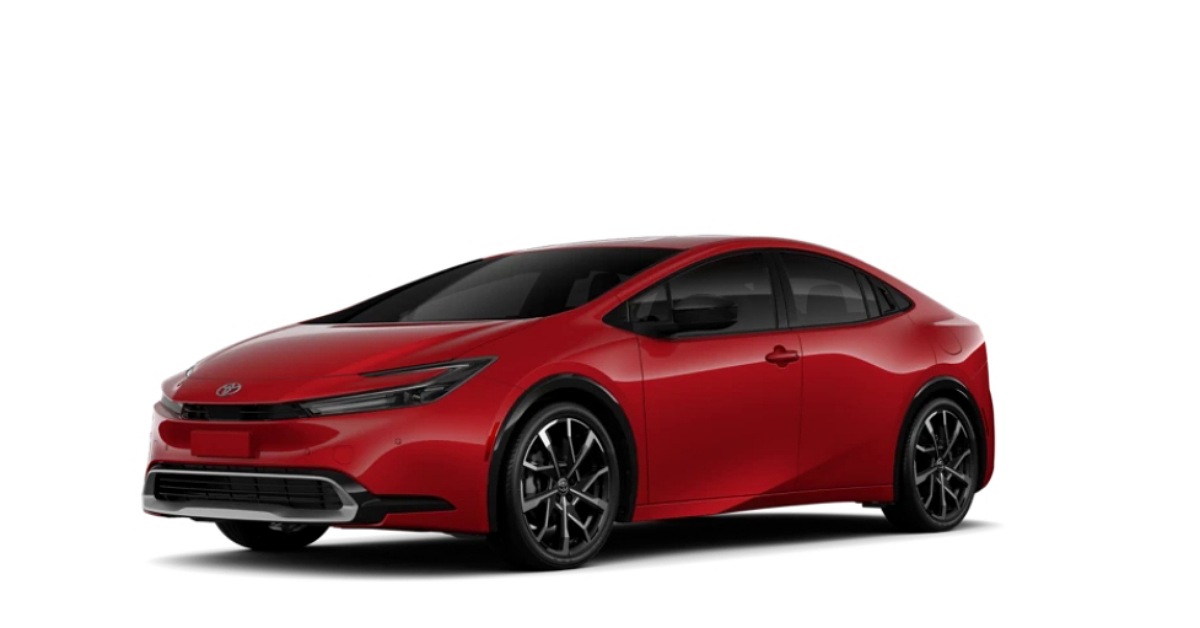
The 2025 Prius Plug-in Hybrid showcases a complete styling transformation that proves hybrids can be genuinely attractive. The exterior design features sharp lines and sculpted body panels that create a dynamic, futuristic look. This isn’t just about aesthetics—the aerodynamic profile directly contributes to improved efficiency by reducing drag through low-hood design, an integrated rear spoiler, and strategically placed underbody panels.
The front end commands attention with its distinctive LED headlights and daytime running lights that provide crisp illumination while enhancing visibility on the road. The compact size and smooth contours make navigating through city streets and tight parking spaces convenient, a significant advantage for urban drivers. The sleek profile emphasizes the vehicle’s commitment to innovation and sustainability.
You’ll find available lightweight 19-inch aluminum alloy wheels that bring a more modern aesthetic, available on higher trims to complement the bold design language. The SE trim comes standard with 17-inch alloy wheels, active grille shutters, and automatic bi-LED headlights. The Prius Plug-in Hybrid offers six exterior color options—Wind Chill Pearl, Guardian Gray, Supersonic Red, Midnight Black Metallic, Cutting Edge, and Reservoir Blue—allowing drivers to personalize their choice.
Interior Review
Inside the cabin, the Prius Plug-in Hybrid balances modern technology with practical comfort. The base SE trim features fabric-trimmed, six-way manual adjustable front seats with a leather-trimmed, heated steering wheel, creating a driver-focused environment. Moving up to the XSE trim, you’ll find SofTex-trimmed seats with an eight-way power-adjustable driver’s seat and available heated front seats that add a layer of comfort during colder months. The XSE Premium trim elevates the experience further with available heated and ventilated front seats—perfect for all-season driving comfort.
The infotainment system is a highlight of the interior experience. All trims feature standard wireless Apple CarPlay and Android Auto capability, making smartphone integration seamless and intuitive. The SE model includes an eight-inch touchscreen with a seven-inch LCD instrument cluster, while the XSE and XSE Premium offer a stunning 12.3-inch multimedia display with integrated navigation and cloud-based voice commands that respond to “Hey Toyota.” The system receives over-the-air updates, ensuring your vehicle stays current with the latest features and improvements.
Standard features include a six-speaker audio system with AM/FM HD Radio and satellite radio capability. Available upgrades on premium trims include an optional eight-speaker JBL Premium Audio system for enhanced sound quality. A wireless smartphone charger and Wi-Fi Connect with an integrated hotspot add modern convenience, while six USB-C ports throughout the cabin keep all passengers’ devices charged.
One drawback many owners note is the gauge cluster setup, which tunnels underneath the windshield with a confusing array of menus and acronyms accessible only through steering wheel controls. Additionally, the low roofline across the rear quarters reduces headroom for taller passengers, and cargo space remains limited compared to other hatchbacks in its class.
Performance & Driving Experience
The 2025 Prius Plug-in Hybrid isn’t designed for thrilling acceleration—it prioritizes efficiency—but it delivers adequate performance for daily driving with genuine capability when needed. The powertrain produces 220 combined horsepower, achieving a 0-60 mph sprint in 6.9 seconds, making the Prius Plug-in Hybrid noticeably quicker than the regular Prius at 7.7 seconds.
The vehicle offers multiple driving modes tailored to different situations. Normal Mode balances fuel economy with performance, Eco Mode limits power to improve efficiency by adjusting throttle response and reducing AC load, and Sport Mode optimizes acceleration for drivers desiring more spirited performance. Three additional modes managed through center-console switches include EV Mode (driving on battery power only), Auto EV/HV (prioritizing battery power while using the gasoline engine when necessary), and Hybrid Mode (standard hybrid operation).
Real-world testing reveals impressive numbers—drivers have achieved close to 40 miles on electric-only mode and maintained over 50 mpg when running the engine, even with a “heavy foot on the accelerator.” Level 2 charging reaches a 50% charge in approximately two hours, making home charging practical for most owners.
The steering is precise with sharp turn-in and tracks straight on the highway without effort. Structural updates and revised suspension components improve overall composure compared to previous generations. The only limitation on performance is the low-rolling resistance tires tuned for efficiency rather than grip—they can become noisy during aggressive maneuvers, though the chassis remains willing.
Features & Technology
The 2025 Prius Plug-in Hybrid is loaded with technology that enhances both connectivity and driver assistance. Toyota Safety Sense 3.0 comes standard on all models, delivering comprehensive driver-assistance features including adaptive cruise control, auto high beams, blind-spot warning with rear cross-traffic alert, forward-collision warning with automatic emergency braking and pedestrian detection, lane centering, lane-departure assist, and road-sign recognition.
The infotainment system’s voice command feature responds naturally to “Hey Toyota” voice commands powered by cloud-based processing. Available features on higher trims include a Panoramic View Monitor (XSE Premium), allowing drivers to see objects around the vehicle on a screen—a significant safety advantage over traditional parking cameras.
Connectivity features include wireless smartphone charger capability and Wi-Fi Connect functionality with integrated hotspot capability available on higher trims. Available Digital Key functionality lets you use your smartphone as your vehicle key, adding modern convenience.
The predictive driving features are particularly clever—the Prius Plug-in Hybrid can recognize stopping patterns on frequently driven routes and suggest when to ease off the accelerator, optimizing deceleration points for maximum efficiency. This real-time feedback system helps drivers develop more efficient driving habits while reducing energy consumption.
Safety Review
The 2025 Prius Plug-in Hybrid achieves IIHS “Top Safety Pick” recognition for the 2024 model year based on excellent performance in small overlap frontal crash tests, updated side impact crash tests, headlight evaluations, and pedestrian crash prevention testing. This prestigious recognition reflects Toyota’s commitment to occupant safety.
All models come standard with comprehensive airbag protection: dual frontal, side chest and side head airbags, plus a driver knee airbag. The National Highway Traffic Safety Administration (NHTSA) testing demonstrates the Prius Plug-in Hybrid’s superior structural rigidity—in 35 mph front crash tests, the Prius consistently outperforms competitors in chest compression and neck injury measurements.
Advanced safety systems include four-wheel antilock brakes with electronic braking distribution (ABS/EBD), traction control, electronic stability control to prevent skidding, and a post-collision automatic braking system that activates after impact to help prevent secondary collisions. Blind-spot warning with rear cross-traffic alert provides constant vigilance, while the rearview camera and available panoramic view monitoring offer 360-degree awareness.
Mileage & Fuel Efficiency
Real-world fuel economy validates Toyota’s EPA estimates, making the Prius Plug-in Hybrid exceptionally practical for budget-conscious drivers. The SE trim achieves EPA-estimated 53 MPG city, 51 MPG highway, and 52 combined MPG with an impressive 127 combined MPGe. XSE and XSE Premium trims deliver 50 city, 47 highway, and 48 combined MPG with 114 combined MPGe.
When maintaining a fully charged battery, many drivers report exceeding EPA combined ratings. One Canadian reviewer logged 460 km of mixed urban and highway driving—including a 260-km round trip to Montreal at 120 km/h—while consuming just 5 liters of fuel. This demonstrates the Prius Plug-in Hybrid’s exceptional real-world efficiency compared to conventional vehicles.
Highway efficiency remains strong even after the battery depletes, with many owners reporting consistent 50+ mpg on the highway—a critical advantage over standard plug-in hybrids that often experience dramatic economy drops once electric power is exhausted. The vehicle’s advanced aerodynamics and efficient CVT transmission contribute significantly to this sustained performance.
Price & Variant Details
The 2025 Toyota Prius Plug-in Hybrid is offered in three trim levels, each delivering different equipment levels while maintaining the core plug-in hybrid benefits:
SE ($33,375 MSRP)
Best value proposition featuring 8-inch touchscreen, 17-inch alloy wheels, active grille shutters, automatic bi-LED headlights, standard Toyota Safety Sense 3.0, wireless Apple CarPlay and Android Auto, six-speaker audio system, and the highest EV range (44 miles) and best combined fuel economy (52 MPG).
XSE ($36,625 MSRP)
Adds luxury features including 19-inch machine-finish alloy wheels, bi-LED projector headlights, front and rear parking sensors with automatic braking, heated front seats, SofTex-trimmed seats with eight-way power adjustment, wireless smartphone charger, and updated infotainment with 12.3-inch display (on higher-spec models).
XSE Premium ($40,070 MSRP)
The loaded option featuring the same core equipment as XSE with enhancements including available heated and ventilated front seats, available panoramic view monitor, and additional premium features. This trim commands a $3,445 premium over the XSE.
The SE trim represents the best value-for-money choice, offering impressive efficiency and range while keeping costs reasonable for budget-conscious buyers. However, if you value convenience features and comfort enhancements, the modest $3,250 upgrade to XSE justifies the investment.
Pros & Cons
Pros:
- Impressive 44-mile all-electric range on base SE trim—genuinely covers most daily commutes
- Exceptional fuel economy at 52 combined MPG means minimal gas station visits
- Attractive, modern exterior design that breaks the stereotypical hybrid mold
- Excellent safety ratings with IIHS “Top Safety Pick” recognition
- User-friendly infotainment system with wireless Apple CarPlay and Android Auto
- Affordable pricing starting at $33,375 MSRP
- Strong warranty coverage: 10-year/150,000-mile hybrid battery warranty
- Access to 55,000+ charging stations across the US
- Outstandingly precise steering and well-balanced chassis
- Intuitive drive mode selection for different driving scenarios
Cons:
- Low roofline reduces rear headroom for taller passengers and limits cargo capacity
- Gauge cluster tucked under windshield with confusing menu system requiring steering wheel controls
- Low-rolling resistance tires prioritize efficiency over grip and can become noisy during spirited driving
- Noise when gasoline engine engages compared to pure-electric operation
- Limited trunk space compared to conventional hatchbacks
- XSE and XSE Premium trims suffer reduced EV range (39 miles versus 44 miles on SE)
- Rear door mechanical button reportedly awkward and difficult to operate
Competitors Comparison
| Feature | 2025 Prius Plug-in Hybrid SE | 2025 Honda Accord Hybrid | 2025 Hyundai Sonata (Non-Hybrid) |
|---|---|---|---|
| Price | $33,375 | Starting ~$36,500 | Starting ~$33,000 |
| Engine | 2.0L 4-cyl gas/electric PHEV | 2.0L 4-cyl hybrid | 2.5L 4-cyl gasoline |
| Combined Power | 220 hp | 219 hp | Gasoline only |
| City/Hwy/Combined MPG | 53/51/52 | 41/38/41 | 28/38/32 |
| Electric Range | 44 miles | N/A (Not PHEV) | N/A |
| Transmission | CVT | CVT | 8-speed automatic |
| EV Capability | Yes – up to 44 miles | No | No |
| Infotainment | 8.0-in touch, wireless CarPlay/Android Auto | Standard tech | Standard tech |
| Safety Rating | IIHS Top Safety Pick | Good ratings | Good ratings |
| Cargo Space | Hatchback limited | Sedan adequate | Sedan adequate |
The Prius Plug-in Hybrid clearly dominates on fuel economy and electric range, making it ideal for environmentally-conscious drivers and commuters. The Honda Accord Hybrid offers better all-around practicality with sedan comfort, while the Hyundai Sonata appeals to traditional buyers prioritizing affordability and space.
Final Verdict
The 2025 Toyota Prius Plug-in Hybrid deserves serious consideration if you’re seeking an affordable, fuel-efficient, stylish car that genuinely reduces your dependency on gasoline. With its impressive 44-mile electric range, exceptional 52 combined MPG rating, and modern design that finally makes hybrids cool, it represents the best plug-in hybrid hatchback value currently available.
Who should buy it?
Daily commuters covering under 44 miles who can charge at home or work will essentially never visit a gas station. Urban drivers seeking minimal operating costs and environmental responsibility will appreciate the efficiency. Budget-conscious buyers wanting hybrid technology without SUV pricing should absolutely test drive this model.
Who should skip it?
Taller drivers requiring substantial rear headroom might find the low roofline frustrating. Buyers prioritizing cargo space over efficiency should consider conventional hatchbacks or SUVs. Those unwilling to commit to regular charging should opt for the standard Prius hybrid instead.
The 2025 Prius Plug-in Hybrid earns our recommendation as an outstanding plug-in hybrid that delivers on its promises without compromise. It’s affordable, efficient, stylish, and genuinely fun to drive—exactly what a modern family car should be.
Frequently Asked Questions
Is the 2025 Prius Plug-in Hybrid good for families?
Yes, it comfortably seats five passengers and offers practical five-passenger seating. However, the limited cargo space and low rear roofline make it better suited for smaller families or those prioritizing fuel economy over cargo capacity.
What is the real-world mileage on the 2025 Prius Plug-in Hybrid?
Real-world testing confirms EPA ratings are conservative. Drivers regularly achieve 50+ MPG on highway driving and have documented over 80 MPG on routes where the battery stays charged. Urban commuters report 45-50 combined MPG with regular charging.
What is the maintenance cost for a Prius Plug-in Hybrid?
Toyota hybrid vehicles don’t cost significantly more to maintain than non-hybrid models. The hybrid battery itself carries a comprehensive 10-year/150,000-mile warranty. Battery replacement, if needed, typically costs $3,000-$8,000, though most owners never require replacement. Standard oil changes, tire rotations, and scheduled maintenance follow normal intervals.
How long does it take to charge the battery?
Level 2 charging (240V) fully charges the 13.6-kWh battery in approximately 4 hours. Level 1 charging (120V standard outlet) takes significantly longer—typically 12+ hours for a full charge.
Can you drive the Prius Plug-in Hybrid without charging?
Absolutely. If you never plug it in, the Prius Plug-in Hybrid operates as a highly efficient conventional hybrid, delivering roughly 52 combined MPG once the battery depletes. It’s designed for drivers who can charge regularly to maximize electric driving, but it never leaves you stranded if charging isn’t convenient.