Read the complete 2025 Toyota Mirai review — explore its hydrogen fuel cell performance, design, features, and real-world experience. Find out if this eco-friendly sedan is right for you.
Introduction
The 2025 Toyota Mirai represents one of the most innovative approaches to sustainable transportation in the automotive world today. This hydrogen fuel cell electric sedan launched in 2020 and has continued to evolve, offering drivers a glimpse into the future of clean energy vehicles. Unlike traditional electric vehicles that require lengthy charging times, the Mirai fills up with hydrogen in just five minutes and delivers an impressive 402-mile range on a single tank. But what makes the 2025 Mirai truly special? Let’s explore why this futuristic sedan is turning heads among eco-conscious drivers who want something truly different from the typical EV crowd.
Key Specifications
Engine & Powertrain
- Engine Type: Hydrogen Fuel Cell Electric
- Motor Power: 182 horsepower
- Motor Torque: 221 lb-ft
- Fuel Cell Type: Solid-polymer-electrolyte proton-exchange membrane
- Battery Capacity: 1.2 kWh lithium-ion (auxiliary battery)
- Transmission: 1-speed automatic direct drive
Performance Metrics
- 0-60 MPH: 9.1 seconds
- Top Speed: 106 mph
- Quarter Mile: 17.0 seconds
Fuel Efficiency & Range
- EPA Rating (Combined): 74 MPGe
- EPA Rating (City): 76 MPGe
- EPA Rating (Highway): 71 MPGe
- Total Range: 402 miles per fill-up
- Hydrogen Tank Capacity: 5.2 kg
Dimensions & Capacity
- Length: 195.8 inches
- Width: 74.2 inches
- Height: 57.9 inches
- Wheelbase: 114.9 inches
- Curb Weight: 4,300–4,350 lbs
- Passenger Capacity: 5 adults
- Trunk Volume: 9.6 cubic feet
Pricing
- Starting Price: $52,990 (XLE trim)
- Special Incentive: Up to $15,000 hydrogen fuel credit (six years for purchases, three for leases)
Exterior Design Review
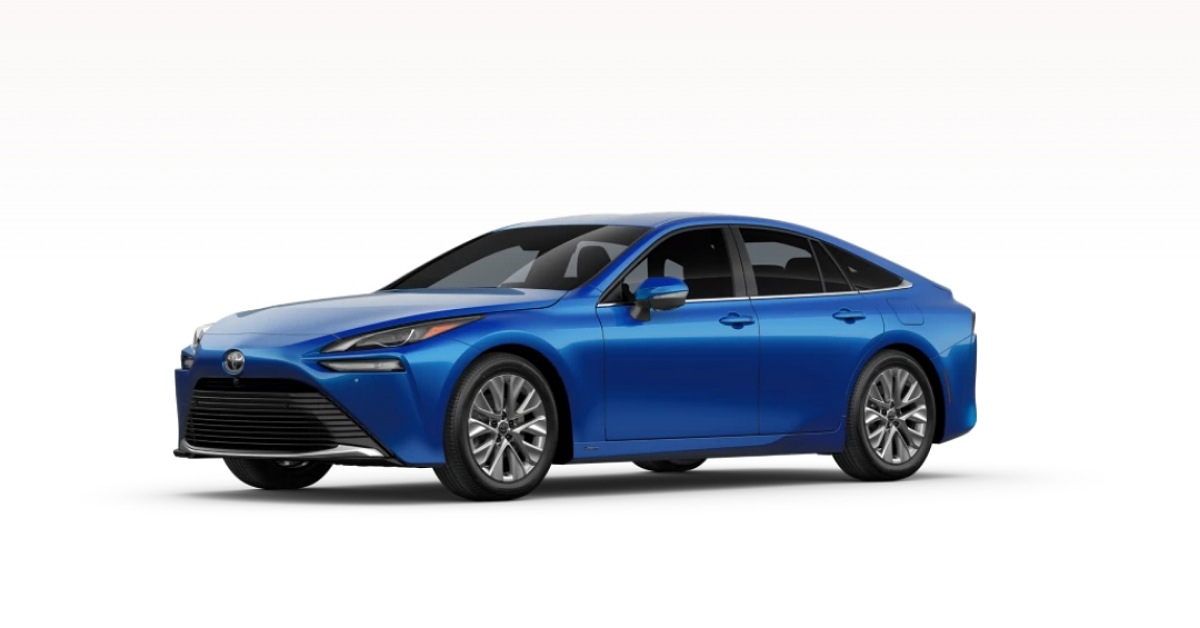
The 2025 Toyota Mirai presents a bold, futuristic design that immediately sets it apart from conventional sedans on the road. This isn’t just a car that’s designed for the future – it looks the part, too. The front fascia features a distinctive grille design that’s unmistakably Toyota, complemented by sleek LED headlights with integrated daytime running lights that give the Mirai a sharp, modern appearance.
The body lines are smooth and flowing, creating an aerodynamic profile that reduces wind resistance and improves fuel cell efficiency. The 19-inch aluminum alloy wheels sit perfectly within the wheel wells, adding to the car’s athletic stance. Available in several attractive exterior colors including Pearl White Multi-Coat, Super Sonic Red, Midnight Black Metallic, and Blueprint, the 2025 Mirai offers drivers choices that match their personal style.
The overall road presence is commanding despite its sedan classification. The slightly raised hood and angular shoulder line create visual muscle, while the gently sloping roofline gives the Mirai a more dynamic profile than traditional midsize sedans. The rear design features a minimalist approach with subtle taillights that complement the modern aesthetic. Build quality appears solid throughout, with tight panel gaps and consistent paint application that reflects Toyota’s commitment to craftsmanship.
Interior Design and Comfort Features
Step inside the 2025 Mirai, and you’ll immediately notice the cabin quality rivals some Lexus models – and that’s intentional. Toyota invested heavily in creating a premium interior environment that matches the vehicle’s eco-conscious positioning. The dashboard is intelligently designed with a black gloss finish accented by copper-colored trim pieces that catch the light beautifully.
The driver and passenger seats feature SofTex synthetic leather upholstery with power adjustment capabilities, allowing both front occupants to find their ideal seating position easily. Heated front seats add comfort during winter months, though they’re not ventilated. The seats offer excellent support for long highway drives, striking a balance between sportiness and comfort. The front center armrest provides ample storage, with a large bin underneath for storing smaller items.
Rear seat passengers enjoy 36.7 inches of headroom and 33.1 inches of legroom, which is adequate for adults but slightly tighter than some competitors. The rear seats feature a three-person bench design, and the center armrest contains cup holders for all three passengers. Overall interior space feels well-utilized, though the hydrogen fuel tank mounted between the rear seat and trunk does limit cargo flexibility.
The 12.3-inch touchscreen infotainment display sits prominently in the center of the dashboard, featuring Toyota’s latest interface software. Wireless Apple CarPlay and Android Auto connectivity come standard, allowing seamless smartphone integration. The infotainment system includes built-in navigation with voice activation, making it easy to find hydrogen charging stations across California. A JBL premium audio system delivers excellent sound quality, featuring multiple speakers positioned throughout the cabin.
Climate control includes dual-zone automatic temperature regulation, ensuring the driver and front passenger can set independent preferences. The air conditioning system cools efficiently even in hot California summers, while the rear passengers benefit from their own climate zones. Storage cubbies are distributed thoughtfully throughout the interior, including a large wireless charging pad for compatible smartphones positioned in the center console.
Performance and Driving Experience
Here’s where the 2025 Toyota Mirai shows its innovative engineering. Powered by hydrogen fuel cell technology, the Mirai delivers a driving experience that’s distinctly different from both traditional gasoline engines and battery electric vehicles. The electric motor provides instant torque delivery, resulting in smooth and responsive acceleration off the line.
City Driving Experience
In urban environments, the Mirai shines as a practical daily driver. The one-speed automatic transmission means smooth power delivery without traditional gear shifts. At low speeds, the car feels nimble despite weighing over 4,300 pounds, thanks to the rear-wheel-drive configuration and well-tuned suspension. The steering feels responsive and well-weighted, making parking and maneuvering in tight spaces manageable. Visibility is good with the standard 360-degree camera system and front and rear parking sensors providing crucial assistance.
Highway Performance
When merging onto highways or cruising at sustained speeds, the Mirai demonstrates composed and refined behavior. The transmission’s single-speed design eliminates the hunting typical of conventional automatics, providing a seamless driving experience. Wind and road noise are well-controlled at highway speeds, and the adaptive cruise control system works excellently for long-distance driving. Acceleration is adequate rather than thrilling – the 9.1-second 0-60 time reflects the vehicle’s environmental focus rather than performance aspirations.
Braking and Handling
The braking system feels powerful and progressive, with four-wheel anti-lock brakes (ABS) providing confident stopping power. Regenerative braking recaptures energy that would otherwise be wasted, converting it back into usable power for the fuel cell system. The suspension setup, featuring a multi-link design up front and a torsion beam rear, handles turns confidently without excessive body roll. The Mirai won’t challenge sports cars on a mountain road, but it rides smoothly over bumpy pavement and handles everyday driving with competence.
Engine Refinement
The fuel cell motor runs nearly silently, eliminating the traditional engine noise associated with combustion engines. This creates a serene driving environment that some enthusiasts will love and others might find a bit disconnected. The near-silent operation makes highway cruising a peaceful experience, though you might miss the auditory feedback you get from traditional engines.
Features and Technology
The 2025 Mirai arrives fully loaded with Toyota’s latest convenience and safety technology, positioning it as a premium offering in its segment. The standard suite of features includes wireless Apple CarPlay and Android Auto, allowing drivers to access navigation, music, and messaging apps through the 12.3-inch touchscreen. Voice activation capabilities let you control functions without taking your hands off the wheel.
Built-in navigation is included, with Toyota’s system specifically updated to identify hydrogen charging stations across California. This is crucial functionality for Mirai owners, as hydrogen infrastructure remains limited outside the Golden State. The system learns your driving patterns and can suggest nearby charging locations before you run low.
The wireless charging pad for compatible smartphones sits conveniently in the center console, eliminating the need for cables and keeping your device organized. A JBL premium audio system with multiple speakers delivers concert-quality sound, making long drives more enjoyable. Steering wheel-mounted audio controls allow you to adjust volume and change tracks without looking away from the road.
The ADAS (Advanced Driver Assistance System) features, collectively called Toyota Safety Sense 3.0, represent the technological highlight. Full-speed range dynamic radar cruise control maintains your set distance from vehicles ahead, automatically accelerating or decelerating as needed. Lane departure alert with steering assist gently nudges the steering wheel if you begin drifting out of your lane. Lane keeping assist actively helps keep the vehicle centered in its lane. Blind-spot monitoring with rear cross-traffic alert protects you during lane changes and when backing out of parking spaces. Forward collision mitigation with pedestrian detection can apply the brakes if an imminent collision is detected.
A panoramic 360-degree camera system provides a bird’s-eye view of the vehicle’s surroundings, making parking in tight spaces considerably easier. Front and rear parking sensors provide audible and visual feedback as you approach obstacles. Integrated turn signal mirrors automatically illuminate the road ahead when signaling turns, improving visibility in those critical moments.
Safety Review
Toyota engineered the 2025 Mirai with safety as a paramount concern. The vehicle received strong safety scores in international crash testing by ANCAP (Australasian New Car Assessment Program), with ratings of 88% for adult occupant protection, 87% for child occupant protection, 80% for vulnerable road user protection, and 83% for safety assist features. While NHTSA 5-star ratings for the 2025 model year are still being assessed, the consistent design approach across model years suggests strong ratings.
The Mirai’s safety features begin with its structure. Seven airbags are strategically positioned throughout the cabin: dual frontal, front side-impact, side-impact head protection, and driver knee airbags. These work in concert with the vehicle’s rigid frame to absorb impact energy while protecting occupants.
Active safety features complement passive protection. The aforementioned Toyota Safety Sense 3.0 suite actively works to prevent accidents before they happen. Blind-spot monitoring alerts you to vehicles in your peripheral vision, reducing the risk of dangerous lane-change collisions. Rear cross-traffic alert warns you of approaching vehicles when backing up. Forward collision mitigation with pedestrian detection represents Toyota’s commitment to protecting not just vehicle occupants but vulnerable road users like pedestrians and cyclists.
Hill start assist prevents the vehicle from rolling backward when starting on grades, useful in mountainous terrain or steep parking lot situations. Brake assist amplifies braking force in emergency situations, helping the vehicle achieve maximum braking power quickly. Anti-lock braking system (ABS) with electronic brake-force distribution (EBD) prevents wheel lockup during hard braking, maintaining steering control in emergency maneuvers.
The vehicle comes with a tire pressure monitoring system that alerts you if any tire is underinflated, an often-overlooked safety feature that prevents blowouts. Child safety locks on rear doors prevent accidental opening while driving, important when transporting young passengers.
Mileage and Fuel Efficiency
The 2025 Toyota Mirai represents the pinnacle of fuel efficiency in the automotive world, at least when measured in equivalent miles per gallon (MPGe). With an EPA-estimated combined rating of 74 MPGe, the Mirai outperforms virtually all battery electric vehicles on the market.
Breaking this down further, the Mirai achieves 76 MPGe in city driving and 71 MPGe on the highway. These figures represent the energy equivalent of traditional fuel consumption, acknowledging that hydrogen contains different energy content than gasoline. In real-world terms, a full tank of hydrogen (5.2 kilograms) provides up to 402 miles of driving range, eliminating range anxiety that plagues some EV owners.
Company-claimed range figures align closely with EPA estimates, suggesting Toyota’s efficiency targets are realistic and achievable. Highway driving does consume hydrogen slightly faster than city driving, as is typical with most vehicles. However, the difference is minimal, unlike some gas-powered cars where highway fuel economy drops significantly.
The efficiency comparison against the Hyundai Nexo, Mirai’s primary competitor, shows the Toyota slightly ahead. The Mirai’s combined MPGe of 74 surpasses the Nexo’s combined rating of 61. This translates to lower hydrogen consumption over the vehicle’s lifespan, though actual real-world differences depend heavily on individual driving habits and road conditions.
One critical factor affecting mileage is hydrogen infrastructure. Since charging is limited primarily to California, Mirai owners must carefully plan longer trips. Apps integrated into the infotainment system help locate nearby charging stations, but the limited network means spontaneous road trips outside California aren’t practical with today’s infrastructure.
Price and Variant Details
For 2025, Toyota simplified the Mirai lineup to a single trim: the XLE. This decision disappoints those seeking more premium features in a Limited trim, but it ensures that all Mirai buyers receive a well-equipped, feature-rich vehicle without compromise.
XLE Trim ($52,990)
The sole trim includes impressive standard features. Power-adjustable heated front seats with lumbar support ensure comfort during long drives. Dual-zone automatic climate control lets driver and passenger maintain different temperatures. The 12.3-inch touchscreen infotainment system comes with built-in navigation, wireless smartphone integration, and Bluetooth connectivity. LED headlights illuminate the road ahead, while heated power-folding side mirrors with integrated turn signals enhance visibility and convenience.
The JBL premium audio system delivers excellent sound quality, with enough power and clarity for music lovers. Wireless charging for compatible smartphones keeps devices powered during your drive. The 360-degree camera system provides multiple viewing angles, and front and rear parking sensors assist with parking maneuvers. Synthetic leather upholstery throughout the interior resists staining and wears well over time.
All Mirai models come with Toyota Safety Sense 3.0, the comprehensive driver assistance package that feels increasingly essential in modern vehicles. Adaptive cruise control, lane departure alert with steering assist, blind-spot monitoring, rear cross-traffic alert, forward collision mitigation with pedestrian detection, and automated emergency braking all come standard.
Pricing and Incentives
The $52,990 starting price places the Mirai in the premium midsize sedan category, comparable to luxury marques like Acura and Infiniti. However, Toyota sweetens the deal with up to $15,000 in free hydrogen fuel. This credit applies to six years of fuel for purchase customers and three years for lease customers, essentially providing no-cost driving for that period. This dramatically reduces the true cost of ownership and makes the Mirai more accessible to environmentally conscious buyers.
Federal tax credits and state incentives in California may further reduce the effective purchase price for qualifying buyers. In California, purchasing a hydrogen fuel cell vehicle qualifies for state rebates and enhanced incentives through agencies dedicated to promoting clean transportation.
Pros and Cons
Pros
The 2025 Mirai delivers a driving experience that’s genuinely innovative. The hydrogen fuel cell technology eliminates tailpipe emissions, producing only water vapor as a byproduct – true zero-emission driving. Five-minute refueling beats battery charging by hours, and the 402-mile range ranks among the best in the industry. The interior quality rivals luxury brands, with premium materials and attention to detail throughout. Toyota Safety Sense 3.0 provides comprehensive driver assistance features that reduce accidents and stress during daily driving. The handling and ride quality are refined, making the Mirai a pleasure for daily commuting. Up to $15,000 in free hydrogen fuel substantially reduces operating costs. The tech stack is modern and intuitive, with excellent smartphone integration. The exterior styling is distinctive and turns heads, making a statement about the owner’s environmental commitment.
Cons
The critical limitation is hydrogen infrastructure availability. Outside California, charging stations are virtually nonexistent, restricting the Mirai’s practicality for most Americans. The single-trim approach limits customization options for buyers seeking different feature combinations. Acceleration is leisurely at 9.1 seconds to 60 mph, disappointing those prioritizing performance. Trunk space at 9.6 cubic feet is restrictive, and it cannot be expanded due to the hydrogen storage tank. The rear seat is tighter than some competitors, with limited legroom for tall passengers. Maintenance costs remain unknown due to the vehicle’s relative rarity and limited service history. Hydrogen fuel prices fluctuate based on availability and demand. The resale market is uncertain due to the vehicle’s niche status and limited infrastructure. Only available in California currently, making it inaccessible to drivers in other states.
Competitors Comparison
2025 Toyota Mirai vs. 2025 Hyundai Nexo vs. Traditional Gasoline Sedans
When shopping for an eco-conscious sedan, the primary competitor to the Mirai is the Hyundai Nexo. Both vehicles use hydrogen fuel cell technology and offer similar environmental benefits. However, they differ in design philosophy and execution.
Price Comparison
- Toyota Mirai XLE: $52,990
- Hyundai Nexo Blue: $60,135
- This $7,145 price difference favors the Mirai, making it the more affordable hydrogen option.
Features and Design
The Mirai follows a sedan design philosophy, offering sleek, car-like proportions. The Nexo adopts an SUV crossover design, providing more ground clearance and a commanding driving position. The Mirai’s interior feels more luxurious, with Lexus-quality materials, while the Nexo emphasizes practicality and utility. Both include excellent infotainment systems and safety features, though the Mirai includes more premium audio and navigation capabilities as standard.
Engine Performance
- Mirai: 182 horsepower, 221 lb-ft torque
- Nexo: 161 horsepower, 291 lb-ft torque
The Mirai produces more horsepower, translating to better acceleration, while the Nexo delivers significantly more torque, potentially beneficial for heavy-duty applications. The Mirai accelerates to 60 mph in 9.1 seconds, while the Nexo takes approximately 9.2 seconds.
Mileage and Efficiency
- Mirai: 74 MPGe combined, 402-mile range
- Nexo: 61 MPGe combined
The Mirai demonstrates superior efficiency, requiring less hydrogen to travel the same distance. This translates to lower operating costs over the vehicle’s lifespan.
Space and Practicality
The Nexo’s SUV design provides more cargo space and higher seating position. The Mirai prioritizes passenger comfort with more front legroom and a car-like driving experience. For families requiring maximum cargo capacity, the Nexo may be preferable. For driver-focused luxury, the Mirai wins.
Warranty Coverage
- Mirai: 3-year/36,000-mile basic, 5-year/60,000-mile powertrain
- Nexo: 5-year/60,000-mile basic, 10-year/100,000-mile powertrain
Hyundai’s warranty is more generous, providing peace of mind for longer ownership periods.
Compared to Traditional Sedans
Unlike gasoline-powered competitors like the Toyota Camry or Honda Accord, the Mirai produces zero tailpipe emissions, making it dramatically cleaner for the environment. Fuel costs are substantially lower with the $15,000 hydrogen credit, though this advantage applies only within California’s limited charging network. Range capabilities match or exceed traditional vehicles, but refueling infrastructure replaces the ubiquitous gas station model that traditional cars enjoy.
Final Verdict
The 2025 Toyota Mirai represents a bold step forward in automotive technology, offering genuine innovation wrapped in a well-executed, premium package. Did you know that the Mirai produces only water vapor as emissions, making it the cleanest hydrogen vehicle on the market? For buyers in California seeking to minimize their environmental impact while enjoying a refined, technology-packed driving experience, the Mirai deserves serious consideration.
Who Should Buy the 2025 Mirai?
The Mirai suits environmentally conscious drivers with regular commutes within California, particularly those living in or near hydrogen station clusters like Los Angeles, San Francisco, and San Diego. Buyers who value technological innovation and don’t prioritize raw performance find the Mirai appealing. Those able to take advantage of the $15,000 hydrogen fuel credit discover exceptional value. Early adopters passionate about supporting hydrogen infrastructure development appreciate the Mirai’s role in this emerging technology.
Who Should Skip It?
Drivers living outside California cannot practically own a Mirai given infrastructure limitations. Those seeking maximum performance or needing large cargo capacity should explore alternatives. Buyers prioritizing rear legroom and trunk space find the Mirai’s constraints frustrating. Performance enthusiasts looking for thrilling acceleration feel disappointed by the leisurely 9.1-second 0-60 time.
Should You Buy or Skip?
If you’re a California resident committed to sustainable transportation, comfortable with the current infrastructure limitations, and prioritizing environmental impact over performance, the 2025 Toyota Mirai is absolutely worth buying. The combination of innovative technology, premium interior quality, comprehensive safety features, and advantageous fuel pricing creates a compelling case. However, if you live outside California or require maximum practicality and performance, reconsider and explore traditional EVs or gasoline vehicles instead.
Frequently Asked Questions
Is the 2025 Toyota Mirai good for families?
Yes, the Mirai accommodates five passengers and includes excellent safety features. However, rear legroom is limited for tall children, and the 9.6-cubic-foot trunk restricts luggage capacity for family road trips. It’s suitable for families with younger children or those prioritizing comfort over maximum space.
What is the real-world mileage of the 2025 Mirai?
EPA estimates project 76 MPGe in city driving and 71 MPGe on highways, translating to approximately 402 miles on a full tank of hydrogen. Real-world results vary based on driving habits, road conditions, and traffic patterns.
What is the maintenance cost for the 2025 Mirai?
Maintenance costs remain relatively unknown due to the vehicle’s rarity and limited service history. Toyota’s warranty covers powertrain components for five years or 60,000 miles, minimizing early maintenance expenses. The fuel cell system has no oil changes or traditional engine maintenance, potentially reducing long-term costs. However, replacing fuel cell components when warranty expires could be expensive.
How long does it take to charge a Mirai?
The Mirai doesn’t charge like battery electric vehicles. Instead, it refuels with hydrogen in approximately five minutes at a dedicated hydrogen station, similar to traditional gas-powered cars. This represents a significant advantage over battery EVs requiring 30 minutes to several hours.
What is the driving range of the 2025 Mirai?
The Mirai travels up to 402 miles on a single tank of hydrogen, exceeding most battery electric vehicles and matching many gasoline-powered sedans. This range eliminates the “range anxiety” that concerns many EV owners.
Where can I charge my Mirai in California?
Hydrogen stations cluster primarily in Southern California (Los Angeles, Orange County, San Diego) and Northern California (San Francisco Bay Area). The Toyota infotainment system includes navigation to nearby stations and displays real-time availability. Planning longer trips is essential due to station spacing.
Is the 2025 Mirai worth the price?
For California drivers committed to environmental responsibility, the Mirai offers exceptional value when factoring in the $15,000 hydrogen fuel credit. Considering the premium interior quality, comprehensive technology, and zero-emission operation, the $52,990 base price is competitive. However, buyers outside California or prioritizing performance should explore alternatives.
How does the Mirai compare to the Hyundai Nexo?
Both are hydrogen fuel cell vehicles with similar environmental benefits. The Mirai offers superior efficiency (74 vs. 61 MPGe), lower pricing ($52,990 vs. $60,135), and more luxurious interior. The Nexo provides more cargo space, better warranty coverage, and an SUV design. Choose based on your priorities: luxury and efficiency favor the Mirai; space and warranty favor the Nexo.
What do you think about the 2025 Toyota Mirai? Does this innovative hydrogen sedan appeal to you, or would you prefer a traditional EV or gasoline vehicle? Share your thoughts in the comments below!