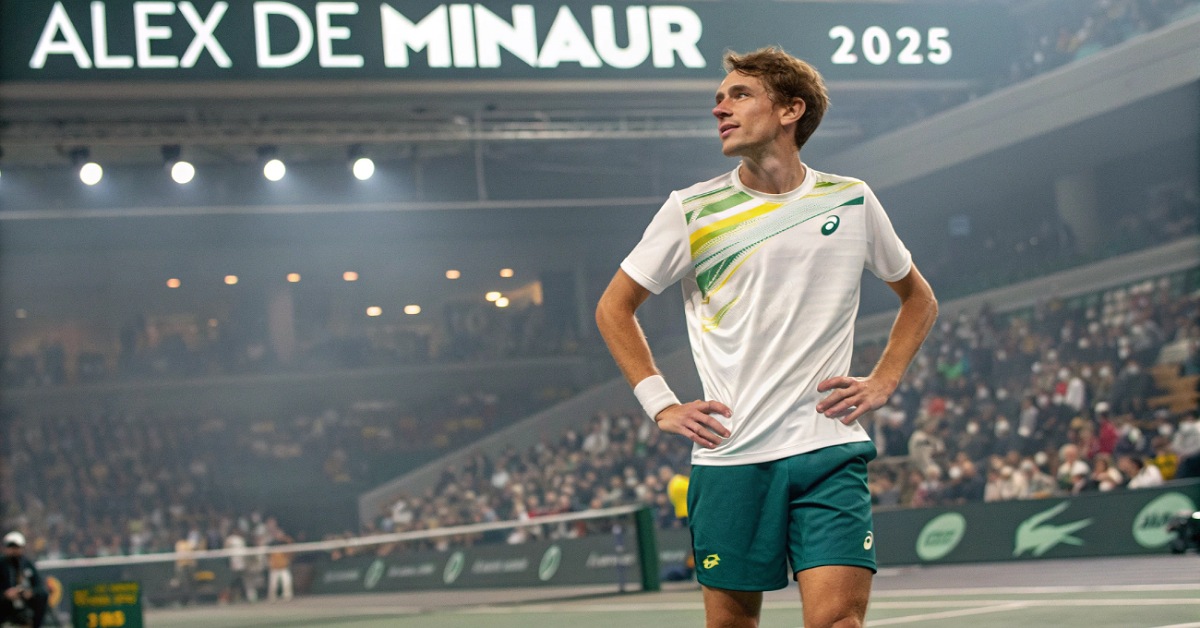
Alex de Minaur has emerged as one of the most compelling stories in professional tennis, combining remarkable athletic talent with refreshing honesty about mental health struggles. The Australian tennis star, now ranked world No. 7, represents a new generation of players breaking through the traditional barriers of the sport while navigating unprecedented levels of competition and psychological pressure.
Who Is Alex de Minaur?
Alex de Minaur Román was born on February 17, 1999, in Sydney, Australia, making him just 26 years old as he reaches the peak of his professional career. Standing 6 feet tall and weighing 152 pounds, de Minaur brings a distinctive blend of speed, precision, and relentless fighting spirit to the tennis court. This combination has made him Australia’s highest-ranked male player and one of only six Australian men to break into the world’s top 10 in singles rankings over the past two decades.
De Minaur turned professional in 2015 and has been steadily climbing the ranks ever since. His breakthrough moment came in January 2024 when he achieved a top-10 ranking for the first time in his career, becoming the first Australian male player to accomplish this feat since Lleyton Hewitt achieved it 17 years earlier. This achievement alone placed de Minaur in elite company, joining legendary Australian tennis figures like John Newcombe, Pat Rafter, and Ken Rosewall.
A Breakthrough 2024 and Historic 2025
The year 2024 marked a turning point in de Minaur’s career trajectory. He claimed his first ATP 500 title at the Mexican Open in February and followed it up with victories at major tournaments throughout the year. His breakthrough reached its climax in July 2024 when he achieved a career-high ranking of world No. 6 after reaching the quarterfinals at Wimbledon, his first time reaching the second week at the All England Club.
What made this achievement particularly significant was the context of Australian tennis history. De Minaur became only the 11th Australian player ever to crack the top 10, joining an exclusive club of sporting legends. Only six Australian men have ever ranked higher than him in singles: John Newcombe, Pat Rafter, and Lleyton Hewitt all reached world No. 1, while Ken Rosewall peaked at No. 2, Rod Laver at No. 3, and Pat Cash at No. 4.
The 2025 season has been equally impressive despite its emotional complexities. De Minaur won his third ATP 500 title in Washington, DC in July 2025, where he saved three championship points in a dramatic final against Spain’s Alejandro Davidovich Fokina. This victory marked his tenth ATP Tour singles title overall, establishing him firmly among tennis’s elite players.
Exceptional Performance at Laver Cup 2025
One of de Minaur’s standout moments in 2025 came at the prestigious Laver Cup in San Francisco in September. Playing under the captaincy of Andre Agassi for Team World, de Minaur delivered a masterclass performance that earned him widespread acclaim. He became the only player on his team who remained unbeaten across the three-day competition, winning all three of his matches.
His victory over world No. 3 Alexander Zverev deserves particular mention. De Minaur produced a dominant 6-1, 6-4 performance, employing a tactical playbook reminiscent of tennis legend Roger Federer. De Minaur strategically used his backhand slice to perfection, adapting to the slow, low-bouncing indoor conditions. After the match, when asked about his tactical brilliance, de Minaur humbly remarked, “I don’t want to say too much, but he wrote the playbook. I just read it,” referring to Federer, who was watching from the stands.
De Minaur’s consistent performance at Laver Cup helped Team World secure a remarkable victory over Team Europe, with de Minaur’s three wins providing crucial momentum for his squad. His performance demonstrated not just his tennis skills but also his ability to deliver under pressure in team competitions.
The Dark Side: Mental Health Struggles and Emotional Turmoil
Despite his on-court success, de Minaur has become increasingly vocal about the psychological challenges inherent in elite professional tennis. His raw honesty about mental health has resonated with fans and sparked important conversations about athlete wellbeing in the sport.
Earlier in 2025, after a disappointing loss at the French Open—where he held a two-set lead against world No. 62 Alexander Bublik before losing—de Minaur took an unprecedented break from professional tennis. He skipped defending his title and took nearly a week off, revealing that he felt mentally exhausted and physically drained. “I was running on fumes,” he admitted, describing a state of complete burnout that even his fiancée and fellow tennis player Katie Boulter couldn’t ease.
De Minaur emphasized the necessity of stepping away from the relentless professional circuit. He spent time living what he described as “a normal human existence,” going out for coffee and dinner, visiting parks, and deliberately disconnecting from tennis. He credited this break with providing perspective about why he was struggling. “I realized how mentally drained and fatigued I had become,” he reflected.
However, the most striking display of his mental health challenges came during the ATP Finals in Turin in November 2025. After serving for the match at 5-4 in the final set against Lorenzo Musetti, de Minaur’s nerves faltered, and he lost the final four games. Immediately afterward, he made an extraordinary candid admission: “I think it’s probably a good thing I don’t express my feelings right now because they’re quite dark.”
A Pattern of Unfinished Business
De Minaur’s struggles have revealed a troubling pattern in his career: the inability to close out matches from winning positions. This issue reached a crisis point during the 2025 season, contributing to what he described as his mental state being “killed” by repeated losses.
His Grand Slam record encapsulates this struggle. Despite reaching six Grand Slam quarterfinals, he remains winless in those matches, holding an 0-6 record in quarterfinals. His US Open quarterfinal loss to Canada’s Felix Auger-Aliassime particularly stung, as he had won the opening set before falling in subsequent rounds. A similar devastating loss at Wimbledon 2024 to 20-time Grand Slam champion Novak Djokovic and another quarterfinal exit at Roland Garros compounded his frustration.
The ATP Finals in November 2025 brought these issues into sharp relief. De Minaur lost in the Jimmy Connors group stage after two matches, with losses to both Carlos Alcaraz and Lorenzo Musetti. He had held winning positions in both matches but ultimately failed to convert them. His words after the Musetti loss revealed the psychological toll: “If I really want to be serious about taking the next step in my career, these matches, I can’t lose them. I just can’t. It feels like I’ve lost a lot of them this year. More than anything, it’s getting to a point where mentally it’s killing me.”
The Road to Recovery and Future Potential
Despite these challenges, de Minaur’s 2025 season has been objectively successful by any measure. According to the Infosys ATP Win/Loss Index, he accumulated a career-best 55 tour-level match wins in 2025, demonstrating consistency and improvement. His ability to win at the highest levels—including the prestigious Washington ATP 500 and his Laver Cup performance—proves he possesses the technical and tactical skills necessary to compete with the world’s best.
What he’s now working to develop is the mental resilience and match execution to transform these near-misses into victories. De Minaur has recognized the need to address these issues with his coaching team and support staff, and his willingness to discuss them publicly may actually accelerate his development. Sports psychology has become increasingly sophisticated, and players who openly acknowledge mental challenges often benefit from targeted interventions.
Changing Mental Approach at Grand Slams
By Wimbledon 2025, de Minaur had begun adopting a new mentality specifically designed to combat his mental fatigue. Instead of obsessing over overall results, he shifted his focus to celebrating small victories and incremental progress. “My mentality has been about taking small wins,” he explained. “Not worrying about the result as a whole, but trying to focus a little bit more on small wins.”
This shift represents a maturation in his approach to the sport. Where his younger self would have been frustrated by an imperfect performance, he began accepting that grinding through tough matches and recovering from slow starts was itself a form of winning. “I look at this match, and probably the old me would definitely not be happy with the way I started,” he noted, “but the way I’m looking at it now is that I’m happy. I reset. I found my game. I battled through.”
What Makes de Minaur Special
Beyond the statistics and rankings, de Minaur stands out for several qualities that define his career and character. First, his speed and movement on the court are exceptional. His ability to defend from difficult positions and turn defense into offense has earned him recognition as one of tennis’s most athletic and relentless competitors.
Second, his grass-court game represents a distinctive strength. He has won ATP titles on grass at Eastbourne and ‘s-Hertogenbosch, demonstrating that he’s not just a hard-court specialist. This versatility is increasingly rare among modern players and suggests he could eventually break through at major championships that demand different tactical approaches.
Third, his willingness to discuss mental health openly has made him an important voice in professional tennis. Players like Alexander Zverev and Andrey Rublev have similarly begun addressing mental health publicly, but de Minaur’s raw honesty—particularly his admission that he was in a “dark place”—reflects a younger generation’s willingness to destigmatize mental health discussions in elite sports.
Finally, his partnership with Katie Boulter, another professional tennis player, adds another dimension to his life. While supporting a partner through their own competitive challenges adds complexity to his schedule, it also provides unique understanding and support from someone who intimately understands the pressures of professional tennis.
Comparing de Minaur to His Peers
In the context of the 2025 tennis landscape, de Minaur occupies an interesting position. He trails the dominant forces: world No. 1 Jannik Sinner (ranked nearly 8,400 points ahead), world No. 2 Carlos Alcaraz, and world No. 3 Alexander Zverev. Yet he competes regularly with these elite players and has demonstrated he can beat them on any given day.
Unlike some players his age who have plateaued, de Minaur continues to improve and expand his game. His tactical adjustments at Laver Cup—implementing the backhand slice effectively—suggest coaching innovations that could pay dividends in future Grand Slam tournaments.
The Next Chapter
Looking forward, the question isn’t whether Alex de Minaur can continue winning ATP titles—he’s already established himself as a multiple-time champion. The question is whether he can break through the psychological barriers that have prevented him from converting quarterfinal positions into semifinal appearances and major championship victories.
His recent comments suggest he’s committed to this work. After his defeat to Fritz in Turin (which he eventually won), de Minaur said he was working “really hard” with his team to sort out the match-closing issues. The fact that he addressed it directly and won his next match suggests the mental adjustments are beginning to take hold.
For American tennis fans and general sports enthusiasts, de Minaur represents something refreshing: a young player at the absolute peak of his powers who’s simultaneously wrestling with the psychological demands of elite sport. His story transcends tennis because it speaks to the universal human challenge of executing under pressure and maintaining mental health while pursuing excellence.
De Minaur’s journey is far from over. His career-high ranking of world No. 6 achieved in 2024 may prove to be just the beginning. If he can solve his match-closing struggles and continue evolving his game tactically, breaking through at Grand Slam tournaments is entirely plausible. And if his continued openness about mental health helps other athletes feel comfortable seeking support, his impact on the sport may extend far beyond any trophy or ranking.
Share your thoughts about Alex de Minaur’s journey in the comments below. What do you think will be the key to unlocking his potential for major championship success?